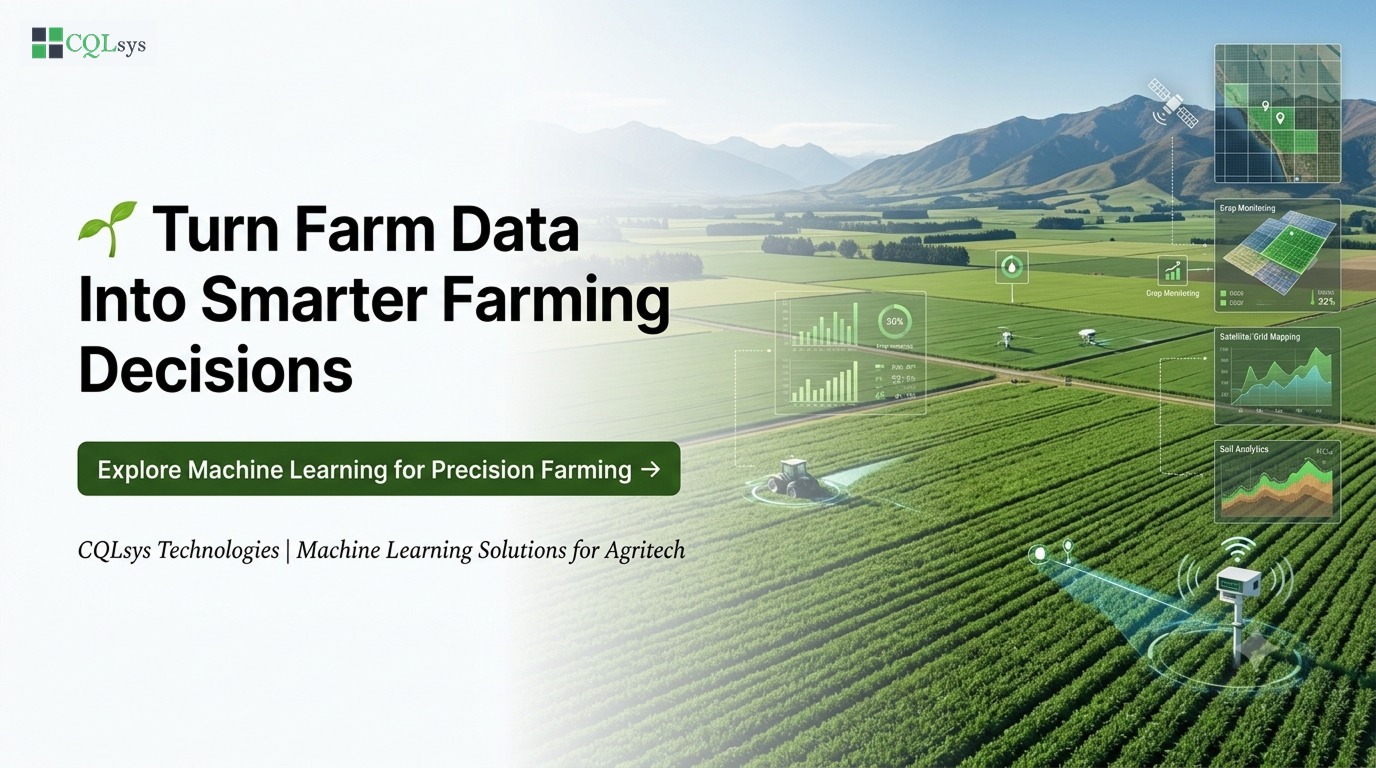
Machine Learning for Agritech Companies in Christchurch: Precision Farming Explained
The agricultural sector across New Zealand is undergoing a structural digital transformation, with Canterbury serving as the national's primary hub for agribusiness innovation. Deploying machine learning solutions for agritech companies in Christchurch has shifted from an experimental technology strategy to an operational necessity. Facing volatile climate patterns, strict environmental regulations on water run-off, rising input costs, and global market demands for sustainable produce, Canterbury agribusinesses require higher precision than traditional farming practices can offer.
Precision farming leverages data-captured by satellite imagery, weather stations, soil probes, and internet-of-things (IoT) connected farm machinery-to make real-time, field-specific decisions. Raw data alone does not yield operational insights. Custom machine learning models process multi-modal agricultural data streams, converting field metrics into actionable insights for predictive yield optimization, automated weed detection, and variable-rate resource application. Building reliable, enterprise-grade software infrastructure requires an architecture tailored to Christchurch's distinct environmental conditions and rural connectivity constraints.
The Christchurch & Canterbury Agritech Landscape
The Canterbury Plains represent one of New Zealand's most productive agricultural regions, characterized by diverse farming models ranging from extensive arable cropping and horticulture to high-density dairy operations. This diversity creates unique technical demands for Christchurch agricultural technology providers. Agritech businesses operating in Christchurch face distinct regional factors that directly influence software development requirements:
- Water Management & Nutrient Regulations: Regional policies set strict limits on water allocation and nitrate leaching. Machine learning systems in Canterbury agriculture must optimize water usage through predictive soil-moisture modeling and targeted variable rate irrigation.
- Microclimate Volatility: Canterbury's proximity to the Southern Alps introduces localized weather events, wind patterns, and rapid temperature fluctuations. Predictive models must process localized microclimate telemetry rather than relying solely on broad regional weather forecasts.
- Connectivity Variations: While Christchurch hosts strong cloud and technology infrastructure, rural field sites in mid-Canterbury experience intermittent connectivity. Software architectures must support edge processing and offline-first data synchronization to remain fully operational in the field.
Core Machine Learning Use Cases in Precision Agriculture
Integrating machine learning algorithms into farm management software transforms raw sensor outputs into operational decisions across several core agricultural functions.
Variable Rate Irrigation & Soil Moisture Prediction
Water allocation is a major operational constraint across the Canterbury Plains. Smart irrigation models analyze real-time data from soil moisture sensors, weather telemetry, and satellite evapotranspiration maps. By forecasting soil moisture levels forty-eight to seventy-two hours in advance, algorithms adjust pivot irrigation systems at a nozzle-by-nozzle level, preventing over-watering and reducing nitrate leaching into local aquifers.
Automated Crop Health Analysis & Disease Detection
Using computer vision models trained on high-resolution drone imagery and multispectral satellite data, custom systems perform comprehensive crop monitoring. Deep learning convolutional neural networks detect early signs of fungal infections, nutrient deficiencies, or pest infestations across large acreage before physical symptoms become visible to field workers.
Targeted Weed Management via Computer Vision
Traditional field spraying applies crop protection chemicals uniformly across an entire field. Integrating computer vision weed detection into tractor-mounted edge hardware allows systems to distinguish between crops and invasive weeds in real time. Classification models trigger targeted spray nozzles only when a weed is identified, reducing chemical usage significantly across a single season.
Predictive Yield Analysis for Harvest Planning
Accurate predictive yield analysis allows growers, distributors, and exporters across Canterbury to optimize supply chain logistics, cold storage availability, and forward-contract commitments. Machine learning regression models combine historical harvest records, seasonal climate trends, satellite vegetation indexes, and soil metrics to predict total tonnage and quality metrics weeks prior to harvest.
Pasture Management & Livestock Allocation
For Canterbury dairy and livestock operations, optimizing pasture allocation directly influences feed costs and milk solids production. Computer vision and satellite analysis platforms estimate pasture biomass, automatically recommending optimal grazing rotation schedules and supplementary feed allocations.
Solution Architecture for Agritech ML Platforms
Building an enterprise agritech platform requires a multi-layered software architecture capable of processing streaming IoT data, raster satellite files, and batch field metrics, while delivering low-latency predictions to mobile apps and farm machinery.
User & Experience Layer
Farm managers, field agronomists, and machinery operators access the platform through responsive web portals and native mobile applications. Given rural field conditions, the mobile layer utilizes local databases to queue field data, sync offline spatial notes, and store locally cached machine learning maps when disconnected from cellular networks.
Ingestion & Security Layer
Sensor networks across Canterbury farms generate high-frequency time-series data. Secure internet brokers ingest stream data from soil probes, weather stations, and telemetry units. Enterprise-grade encryption protects data in transit, while modern identity management protocols govern user permissions and system access.
Machine Learning Pipeline & Feature Store
Raw agricultural telemetry undergoes automated cleaning, spatial normalization, and feature extraction. Extracted metrics feed into a centralized storage feature engine. Trained models are optimized to execute either as cloud-hosted web microservices or as edge-deployed applications running directly on field machinery.
Unified Data Layer
Agritech systems rely on multi-model database setups to handle diverse data types:
- Spatial Database: Manages boundary polygons, elevation contours, and zone geometries using spatial extension engines.
- Time-Series Database: Stores high-frequency metric readings from thousands of connected farm sensors.
- Object Storage: Stores high-volume satellite imagery layers, orthomosaics, and thermal drone captures.
Recommended Agritech Technology Stack
Selecting the correct technology stack ensures system stability, scalability, and seamless integration with third-party farm equipment.
- Frontend Applications: React.js and React Native provide responsive web dashboards and offline-capable cross-platform mobile applications for field technicians.
- Backend Services: Node.js and Python FastAPI power microservices that handle business logic, application programming interfaces (APIs), and complex geospatial calculations.
- Machine Learning Core: Python, PyTorch, TensorFlow, and OpenCV drive deep learning algorithms, computer vision pipelines, and predictive yield engines.
- Edge Computing Runtime: ONNX Runtime and NVIDIA TensorRT execute lightweight weed and disease detection models directly on tractor hardware.
- Geospatial & Analytics: PostGIS, GDAL, and Rasterio ingest, clip, and process multi-spectral satellite layers and vector boundary files.
- Data Storage: PostgreSQL, TimescaleDB, and cloud object storage manage relational farm structures, time-series sensor readings, and large raster imagery datasets.
- Cloud Infrastructure: AWS or Microsoft Azure host scalable cloud pipelines, serverless event structures, and managed machine learning endpoints.
Traditional vs. Machine Learning-Driven Precision Farming
Transitioning from conventional farm management or basic rules-based software to an intelligent agritech software model yields distinct operational improvements:
- Irrigation Scheduling: Traditional methods rely on fixed calendar schedules or manual soil testing. Rules-based software triggers watering only when a sensor drops below a static threshold. Machine learning models predictively adjust water delivery based on evapotranspiration trends and upcoming microclimate forecasts.
- Crop Protection: Conventional farming applies uniform chemical spraying across entire paddocks on set intervals. Rules-based tools store manual digital notes. Machine learning systems use computer vision to identify weeds or pests in real time, triggering precise spot-spraying.
- Yield Forecasting: Traditional farming depends on manual historical sampling and visual estimations. Basic software relies on simple historical average spreadsheets. Machine learning regression processes complex satellite, climate, and soil interactions for highly accurate yield predictions.
- Equipment Operations: Older approaches require manual operator adjustments in the field cab. Basic platforms offer simple GPS tracking and static line guidance. Machine learning solutions generate automated variable-rate prescription maps fed directly into tractor control consoles.
Implementation Roadmap for Christchurch Agritech Companies
Deploying custom machine learning solutions into an agritech product line or agribusiness workflow requires a phased development strategy:
- Discovery & Data Audit: Define specific business objectives, such as reducing irrigation water consumption by a target percentage, and audit existing dataset quality, spatial resolution, and historical sensor logs.
- Data Pipeline & Infrastructure Setup: Establish secure cloud ingestion pipelines for IoT sensors and third-party satellite data services while deploying spatial database structures and data normalization routines.
- Model Development & Validation: Clean, annotate, and augment training datasets. Train baseline models and validate them against verified ground-truth field data collected from local Canterbury agricultural sites.
- Solution Architecture & Edge Integration: Package validated models into microservices or runtimes optimized for edge hardware, while building user interfaces for desktop management and mobile field use.
- Field Testing & Pilot Deployment: Run pilot programs on selected Canterbury test paddocks during active growing seasons to monitor model accuracy, processing speed, offline synchronization, and real-world results.
- Production Launch & Continuous Improvement: Deploy the full platform across operational farm areas and establish continuous learning loops so models update as new seasonal field data arrives.
Cost Factors, ROI, and Business Impact
Developing custom software platforms that incorporate machine learning represents a strategic investment. System costs depend on structural technical variables rather than arbitrary pricing models.
Primary Cost Drivers
- Data Complexity & Volume: Ingesting high-resolution multi-spectral imagery requires higher data storage and GPU processing pipelines than basic numerical sensor data.
- Edge Execution: Running computer vision models directly on farm machinery requires specialized edge hardware integration, increasing testing complexity compared to pure cloud processing.
- Third-Party Equipment Integration: Connecting legacy farming equipment through standardized agricultural buses or proprietary vendor interfaces requires custom integration software adapters.
Quantifiable Business Impact & ROI
- Input Cost Reduction: Automated variable-rate applications lower chemical and fertilizer costs by fifteen to thirty-five percent through precise spot application.
- Resource Conservation: Optimized irrigation reduces water pumping electricity costs and conserves seasonal water allocations.
- Yield Protection: Early detection of disease outbreaks and pest pressures mitigates crop loss before widespread damage occurs.
- Regulatory Compliance Efficiency: Automated collection of input data simplifies compliance reporting for local authorities, reducing administrative overhead.
Security, Data Ownership, and Regulatory Compliance
Agricultural data is a valuable asset containing proprietary operational details, yield performance metrics, and land management history. Robust software engineering must ensure strict security controls:
- Farm Data Ownership & Privacy: Agribusinesses demand clear technical boundaries ensuring operational data is not shared with third parties or aggregated without consent. Multi-tenant database isolation ensures data privacy across competing enterprise clients.
- Data Encryption: All telemetry transmitted from field sensors to cloud systems must use modern encryption standards, with database records encrypted at rest.
- Hardware and Network Security: Sensor nodes and edge gateways deployed across rural properties must feature secure firmware to prevent unauthorized network access or falsified telemetry injection.
- Environmental & Water Reporting Compliance: Systems should store historical operational logs securely, providing immutable audit trails for regional council environmental reporting.
Why Choose CQLsys Technologies for Agritech Software Development
Building scalable, commercial-grade agricultural software requires a development partner capable of bridging the gap between advanced cloud architectures and practical rural usability. CQLsys Technologies provides engineering capabilities tailored to agribusiness digital transformation.
- Custom Software & AI Engineering: From custom deep learning models to complete web and mobile applications, CQLsys designs tailored platforms that match specific agricultural workflows. Learn more about our technical services on our Software Development and AI Development expertise pages.
- Geospatial & IoT Integration Expertise: Our architecture teams hold deep experience building systems that combine real-time IoT time-series data, spatial database layers, and cloud infrastructure.
- Offline-First Mobile Systems: We design mobile solutions built for rural environments, ensuring field technicians and farm managers can perform work offline without data loss.
- End-to-End Enterprise Solutions: From initial architectural discovery to ongoing cloud management and continuous model retraining, CQLsys acts as a long-term technology partner. Explore our full capabilities across our Services Portfolio or read our company background on About Us.
Frequently Asked Questions
1. How does machine learning improve precision farming in Christchurch?
Machine learning analyzes real-time and historical data from Canterbury field sensors, weather feeds, and satellite imagery. It automates complex decisions-such as identifying exact crop water requirements, detecting early crop diseases, and creating variable-rate spraying prescriptions-allowing farms to increase crop yields while minimizing fertilizer, chemical, and water usage.
2. What IoT sensors integrate best with agritech software?
Modern platforms ingest data from diverse hardware, including telemetry-enabled soil moisture probes, automated weather stations, optical foliage sensors, flow meters, and tractor telemetry units. Standardized web and messaging protocols ensure seamless integration across multi-vendor sensor networks.
3. How long does it take to deploy a custom ML model for agriculture?
Developing a custom agricultural machine learning model typically takes three to six months, depending on data availability and model complexity. Initial phases involve data collection and cleaning, followed by model training, offline validation, and pilot field testing across a growing season to ensure field accuracy.
4. Can ML models function offline in rural Canterbury areas with poor connectivity?
Yes. Models can be optimized and deployed directly onto edge hardware-such as tractor consoles or mobile devices-using lightweight runtime engines. Edge models execute predictions locally without an active internet connection and sync data to the cloud once connectivity is re-established.
5. What is the ROI of implementing machine learning in Canterbury agribusinesses?
ROI stems directly from reduced input costs and protected yield quality. Precision applications typically reduce water and fertilizer consumption by fifteen to thirty percent, lower chemical spray usage through spot application, and prevent crop loss through early pest detection, delivering return on investment within one to two growing seasons.
6. How does computer vision help in weed and pest management?
Computer vision systems analyze high-resolution images captured by cameras mounted on sprayers or drones. Neural networks identify specific weed species or insect damage patterns in milliseconds, allowing automated machinery to trigger spot-spraying nozzles only where pests or weeds are present.
7. What data infrastructure is needed for agricultural machine learning?
A robust agritech infrastructure requires a spatial database for field boundaries, a time-series database for IoT metrics, object storage for satellite imagery, and secure ingestion channels. Centralizing these data streams in a secure cloud pipeline is essential for ongoing model training.
8. How does variable rate irrigation reduce water consumption in Canterbury?
Variable rate irrigation models combine real-time soil moisture metrics, field topography layers, and localized weather forecasts. Rather than applying a uniform layer of water across an entire field, the system adjusts pivot speed and individual nozzle output, placing water only where soil profiles require it.
9. How can legacy farm equipment connect to modern software platforms?
Legacy machinery connects via aftermarket telemetry gateways, retrofitted sensor packages, or standardized agricultural bus controllers. These hardware adapters bridge analog or isolated machinery hardware to modern cloud systems, allowing variable-rate prescription maps generated by software to control older equipment.
10. Why partner with CQLsys for agritech software development?
CQLsys Technologies brings end-to-end software engineering capabilities, combining expertise in artificial intelligence, enterprise cloud architecture, geospatial processing, and mobile app design. We build scalable, custom technology solutions designed specifically around your operational goals and target user requirements.
Ready to Build Your Precision Agritech Platform?
Transforming agricultural data into commercial value requires scalable, robust software architecture tailored to your business needs. Whether you are expanding an existing agritech product line or engineering a new machine learning-driven platform for Canterbury's primary sector, CQLsys Technologies provides the enterprise software engineering expertise required to bring your solution to market.
Contact Our Technology Team today to schedule an architectural consultation and explore how custom software development can advance your precision farming initiatives. Connect with us on LinkedIn, Facebook, or Instagram to follow our latest software engineering insights.