6-Month AI Industrial Training in Chandigarh with Live Projects: Enrolment Guide for 2026
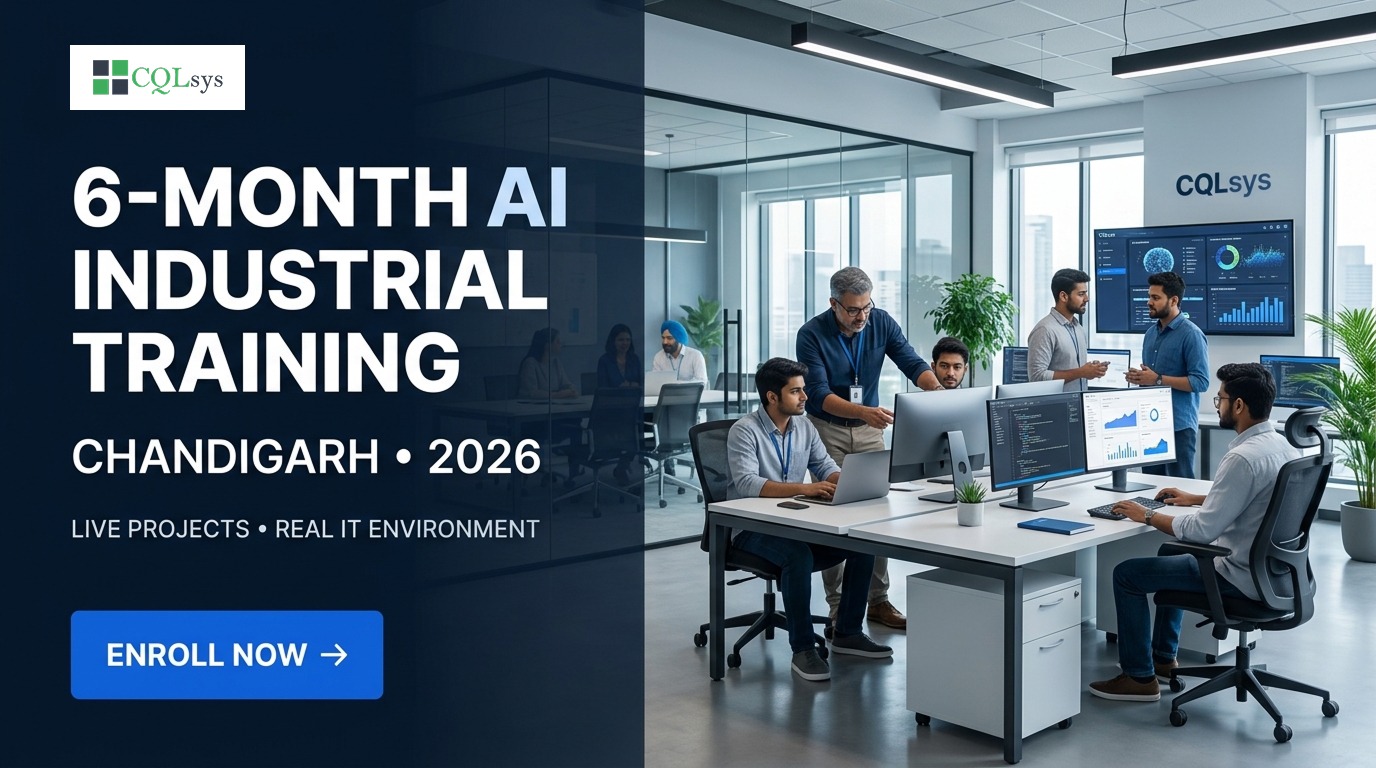
Introduction: The 2026 Artificial Intelligence Engineering Imperative
The global technology landscape in 2026 demands far more than theoretical understanding or standalone script writing from emerging software professionals. Enterprise organizations are rapidly migrating from exploratory pilot projects to full-scale production deployments of Autonomous Agents, Large Language Model (LLM) orchestration pipelines, and Real-Time Computer Vision systems.
Consequently, enrolling in a robust 6-Month AI Industrial Training in Chandigarh with Live Projects has emerged as the definitive bridge between traditional academic computer science curricula and high-yield technical careers. As engineering departments across global enterprises shift toward AI-native architectures, candidates seeking placement must prove their capacity to build, optimize, and deploy scalable machine learning models within complex production environments.
For B.Tech CSE graduates, MCA scholars, and aspiring software engineers, selecting the right AI industrial training Chandigarh with live projects represents a critical career decision. While standard academic coursework introduces underlying mathematical concepts, it frequently leaves candidates unprepared for enterprise-grade challenges such as dynamic data drift, high-latency inference, model drift monitoring, containerized microservices deployment, and robust continuous integration/continuous deployment (CI/CD) pipelines for Machine Learning (MLOps). By completing a structured 6-Month AI Industrial Training in Chandigarh for 2026 enrolment, students position themselves at the intersection of local industry demand and global software architecture standards.
The Evolving IT Landscape of Chandigarh & Mohali Tricity Region
The Chandigarh Tricity region—encompassing Chandigarh, Mohali, and Panchkula—has established itself as one of Northern India's premier technology and software engineering corridors. Anchored by the Rajiv Gandhi Chandigarh Technology Park (RGCTP) and the expansive IT sectors of Mohali (Sectors 67, 74, and 82), the region hosts a high density of product-based software enterprises, global capability centers (GCCs), and agile IT consulting firms. This dense ecosystem creates an unprecedented demand for localized, industry-ready artificial intelligence talent.
Participating in a practical AI training program Chandigarh Mohali enables candidates to immerse themselves directly within this bustling technology corridor. Local software firms no longer seek candidates who require six months of internal onboarding; they demand engineers who can immediately commit clean code, build microservices with FastAPI, design retrieval-augmented generation (RAG) frameworks, and maintain production cloud environments on AWS or Azure. Pursuing Generative AI and LLM industrial training in Mohali Chandigarh provides students with proximity to senior architects, enterprise project managers, and real-world deployment challenges that purely online or academic courses cannot replicate.
Why Traditional Academia Falls Short: The Live Project Advantage
Academic institutions provide vital theoretical foundations in linear algebra, calculus, and basic algorithms. However, a significant gap remains between passing a university examination and building an enterprise-ready AI system. The primary differentiator of a world-class artificial intelligence internship in Chandigarh is direct exposure to production-grade live client projects.
- Dirty, Unstructured Real-World Data: University assignments provide perfectly cleaned CSV files. Live client projects involve handling missing attributes, noisy sensor streams, corrupted images, and imbalanced classification datasets.
- Scalability and Latency Constraints: Running a Jupyter Notebook locally on a small dataset differs drastically from serving low-latency model predictions to thousands of concurrent users via RESTful APIs.
- MLOps & CI/CD Pipelines: Enterprise software engineering requires versioning datasets with DVC, wrapping services in Docker containers, orchestrating workloads via Kubernetes, and establishing automated retraining loops.
- Commercial Accountability: Building for live enterprise clients enforces strict compliance with security protocols, ethical AI guidelines, and ROI-driven business requirements.
Comprehensive Curriculum & Module Breakdown
The 2026 curriculum for the 6-month AI industrial training program is engineered around a progressive learning model, transitioning candidates from foundational software engineering to advanced deep learning and Generative AI orchestration.
Module 1: Advanced Python, Software Design & Data Engineering
Students begin by mastering object-oriented Python, asynchronous programming, computational linear algebra, and optimized data processing using NumPy, Pandas, and Polars. Emphasizing clean code principles, clean architecture, and version control (Git/GitHub), this module ensures candidates build software with enterprise maintainability in mind.
Module 2: Machine Learning Algorithms & Statistical Modeling
Focusing on foundational supervised and unsupervised learning, candidates build and tune decision trees, random forests, gradient boosting frameworks (XGBoost, LightGBM), and support vector machines. Supervised and unsupervised pipelines are evaluated using rigorous mathematical metrics, including Precision-Recall AUC, F1-Score, and ROC analysis, backed by cross-validation frameworks.
Module 3: Deep Learning Frameworks (PyTorch & TensorFlow)
Moving into neural networks, candidates leverage PyTorch and TensorFlow training Chandigarh methodologies to build multi-layer perceptrons, Convolutional Neural Networks (CNNs) for image classification and segmentation, and Recurrent Neural Networks (RNNs/LSTMs) for time-series forecasting and sequence handling.
Module 4: Computer Vision & Natural Language Processing (NLP)
This phase covers advanced domain applications. Computer vision modules explore object detection using YOLOv10 and OpenCV, alongside semantic segmentation. The NLP track dives into transformer architectures, BERT embeddings, sequence-to-sequence translation, and sentiment extraction engines.
Module 5: Generative AI, LLMs & Retrieval-Augmented Generation (RAG)
Addressing 2026's most transformative technology shift, candidates learn LLM fine-tuning industrial training practices. Students construct RAG pipelines using LangChain, LlamaIndex, and vector databases (Pinecone, Qdrant, ChromaDB), while applying Parameter-Efficient Fine-Tuning (PEFT) and LoRA techniques to open-source models like Llama 3 and Mistral.
Module 6: Enterprise MLOps, Cloud & Live Project Deployment
The culmination of the 6-month industrial training focuses on production engineering. Candidates containerize AI applications using Docker, deploy scalable microservices using FastAPI, configure Kubernetes cluster orchestration, and set up continuous monitoring on cloud platforms like AWS and Azure.
High-Level Solution Architecture for Enterprise AI Applications
To succeed in a modern production environment, trainees must understand how individual models fit into a broader, enterprise-grade application architecture. Below is the technical architecture flow taught and implemented during live project execution:
User Experience Layer (React / Next.js / Mobile)
↓
API Gateway & Security Layer (Cloudflare WAF / OAuth2 / JWT / Rate Limiting)
↓
Application & Business Logic Services (FastAPI / Node.js Microservices)
↓
AI Processing & Orchestration Engine (PyTorch / LangChain / RAG Pipeline)
↓
Data & Storage Layer (PostgreSQL / Redis / Vector Database / AWS S3)
↓
MLOps Infrastructure & Monitoring Layer (Docker / Kubernetes / MLflow / Prometheus)
Layer Breakdown & Functional Responsibilities
- User Experience & Presentation Layer: Interfaces built using modern frameworks (React.js, Next.js, or Native Mobile SDKs) communicate securely with back-end endpoints, providing clean UI components for end-users and administrators.
- Security & Gateway Layer: Implements web application firewalls (WAF), rate-limiting, and OAuth2/JWT token validation to ensure enterprise data security and protection against API abuse.
- Application Services Layer: Lightweight microservices powered by FastAPI process incoming business requests, validate inputs, and handle communication with asynchronous queue systems like Celery or Redis Streams.
- AI Orchestration Engine: Executes real-time model inference, orchestrates vector search retrievals across specialized databases, and handles prompt engineering chains for Generative AI applications.
- Data Infrastructure Layer: Relational databases (PostgreSQL) hold core application state, in-memory caches (Redis) accelerate response times, vector stores manage embeddings, and object storage handles unstructured media assets.
- MLOps & Observability Layer: Containerized infrastructure managed via Kubernetes ensures automatic scaling, while MLflow tracks model lineage and Prometheus monitors pipeline health and latency metrics.
Technology Stack & Tooling Matrix
The 6-month program equips trainees with a comprehensive suite of modern, industry-standard tools across the entire AI engineering lifecycle:
| Layer / Domain | Primary Tools & Frameworks | Enterprise Purpose |
|---|---|---|
| Programming Languages | Python, C++, SQL | Core model development, database querying, and high-performance algorithms. |
| Machine Learning & Math | Scikit-Learn, NumPy, Pandas, Polars, XGBoost | Data manipulation, statistical analysis, and classical ML modeling. |
| Deep Learning | PyTorch, TensorFlow, Keras | Neural network architecture design, training, and custom layer creation. |
| Generative AI & LLMs | LangChain, LlamaIndex, Hugging Face Transformers | RAG orchestration, LLM application development, and prompt engineering. |
| Vector Databases | Pinecone, Qdrant, ChromaDB, PGVector | High-dimensional vector storage, semantic search, and document retrieval. |
| Computer Vision / NLP | OpenCV, YOLOv10, Spacy, NLTK, MediaPipe | Visual recognition, video analytics, and textual sentiment processing. |
| Backend & API Integration | FastAPI, Flask, REST APIs, GraphQL | Serving low-latency model inference endpoints to web and mobile frontends. |
| MLOps & Cloud DevOps | Docker, Kubernetes, AWS SageMaker, MLflow, Git | Containerization, cluster management, model tracking, and CI/CD pipelines. |
Real-World Enterprise Live Project Use Cases
Trainees enrolled in the 6-Month AI Industrial Training in Chandigarh with Live Projects gain direct experience working on active commercial applications across diverse enterprise domains:
1. Healthcare: Automated Medical Imaging & Diagnostic Assistance
Students build computer vision pipelines that process high-resolution DICOM imagery to assist radiologists in identifying anomalous tissue growth. The system incorporates multi-modal models to automatically draft preliminary diagnostic summaries using fine-tuned medical LLMs.
2. FinTech: Real-Time Fraud Detection & Credit Scoring
Participants engineer high-throughput ML pipelines capable of processing thousands of financial transactions per second. Utilizing XGBoost and graph neural networks, the platform identifies suspicious patterns, evaluates credit risk dynamically, and triggers automated fraud alerts with minimal latency.
3. E-Commerce & Retail: Intelligent Personalization & Visual Search
Trainees deploy multi-modal recommendation systems that combine collaborative filtering with visual similarity algorithms. Users upload an image of a garment to search across vast product catalogs, while real-time vector search returns visually and contextually similar merchandise.
4. Enterprise Logistics: Predictive Maintenance & Supply Chain Optimization
Students construct time-series forecasting models using IoT sensor streams to predict industrial equipment failure prior to breakdown, optimizing route scheduling and reducing unplanned downtime for logistics fleets.
Comparative Analysis: Traditional Courses vs. Industrial Training
| Feature / Dimension | Standard Academic / Online Courses | 6-Month AI Industrial Training (CQLsys) |
|---|---|---|
| Primary Focus | Theoretical concepts & basic syntax | Production software engineering & MLOps |
| Project Work | Toy datasets (e.g., Iris, Titanic CSVs) | Live enterprise client projects & raw data pipelines |
| Deployment Training | Rarely extends beyond local Jupyter Notebooks | Full cloud deployment (AWS/Azure) with Docker & APIs |
| Generative AI Depth | Basic API calls to commercial endpoints | Custom RAG systems, vector DBs, and LLM fine-tuning |
| Code Quality & Reviews | Self-graded or pass/fail scripts | Strict code reviews by senior software architects |
| Career & Placement Support | Generic resume templates & job board links | 1-on-1 mock technical interviews, portfolio builds & referrals |
Security, Compliance & Responsible AI Practices
Building artificial intelligence solutions for modern enterprise clients demands strict adherence to global security and regulatory frameworks. The 6-month industrial program incorporates robust modules covering:
- Data Privacy & Protection: Implementing strict data anonymization, encryption at rest and in transit (TLS 1.3), and compliance with GDPR, HIPAA, and local data protection regulations.
- Adversarial Robustness & Vulnerability Mitigation: Protecting generative models against prompt injection attacks, data poisoning, and unauthorized extraction of proprietary model weights.
- Model Explainability & Ethics: Utilizing SHAP (SHapley Additive explanations) and LIME to interpret complex black-box model decisions, ensuring non-discriminatory credit scoring, hiring, and healthcare predictions.
- Governance & Lineage: Documenting data provenance, model tracking via MLflow, and maintaining detailed audit trails for regulatory compliance.
Implementation Roadmap: The 6-Month Trainee Progression
The structured 6-month journey transforms participants into industry-ready AI professionals through a clear, phased approach:
- Month 1 (Foundation): Advanced Python mastery, clean software architecture, mathematical foundations, Git collaboration, and relational database management.
- Month 2 (Classical ML & Statistics): Supervised and unsupervised learning, feature engineering, exploratory data analysis, hyperparameter tuning, and statistical validation.
- Month 3 (Deep Learning & Computer Vision): Neural network construction with PyTorch, image processing, object detection models, and spatial analytics.
- Month 4 (NLP & Generative AI): Transformer models, vector embedding creation, LangChain development, RAG architecture execution, and LLM fine-tuning.
- Month 5 (Live Client Project Immersion): Integration into active engineering teams, working on live client software builds, API development, and system integration.
- Month 6 (MLOps, Cloud Deployment & Placement Prep): Containerization, CI/CD pipeline establishment, cloud hosting, mock technical interviews, resume polish, and placement drives.
Why Choose CQLsys Technologies for AI Industrial Training in 2026?
As an established enterprise custom software and AI development company, CQLsys Technologies stands in a unique position to deliver authentic industrial training in Chandigarh and Mohali. Unlike traditional training institutes that focus purely on classroom lecturing, CQLsys is an active software engineering organization building robust digital solutions for clients worldwide across web, mobile, and cloud environments.
When you join the CQLsys Technologies AI training program, you step directly into a live engineering studio environment. Trainees work alongside seasoned solution architects, senior developers, and product managers. You will write code that adheres to production standards, participate in daily agile standups, submit pull requests subject to peer code review, and contribute to software applications serving real business needs. Explore our comprehensive range of IT and software development services to understand the depth of technical expertise backing our training initiatives.
Beyond technical instruction, CQLsys provides end-to-end career guidance, including portfolio building, live GitHub repository curation, technical resume refinement, and placement support across our network of enterprise partners in the Tricity technology corridor and beyond.
10 FAQs
1. What makes 6-month AI industrial training in Chandigarh essential for 2026?
In 2026, enterprise tech employers prioritize practical MLOps skills, Generative AI integration, and cloud deployment over theoretical knowledge alone. A 6-month industrial training program bridges the gap between college academics and enterprise software demands by delivering hands-on experience on live production applications.
2. Are live client projects included in the Chandigarh AI training program?
Yes, active participation in production-level live projects forms the core of the program. Trainees work with real unstructured datasets, design microservices, build vector search engines, and deploy machine learning models under the direct mentorship of senior technology consultants.
3. What prerequisites are required for 6-month AI industrial training?
Applicants should have a basic understanding of computer science concepts, object-oriented programming, and elementary mathematics. The program is ideal for final-year B.Tech CSE, IT, MCA, or M.Tech students, as well as early-career developers looking to transition into AI engineering.
4. How does MLOps integration differ from basic AI certification courses?
Basic courses typically end inside local Jupyter Notebooks. MLOps integration teaches students how to containerize models using Docker, orchestrate deployments with Kubernetes, build RESTful APIs via FastAPI, track model lineage using MLflow, and monitor performance on live AWS/Azure infrastructure.
5. What career roles can I target after AI industrial training in Chandigarh?
Graduates can confidently apply for high-demand roles such as AI Engineer, Machine Learning Developer, MLOps Specialist, Generative AI Consultant, Computer Vision Developer, NLP Engineer, and Data Engineer across product startups and enterprise IT firms.
6. Is placement assistance guaranteed after completing the training?
CQLsys Technologies provides comprehensive placement support, including technical portfolio creation, GitHub optimizations, 1-on-1 mock interviews, resume preparation, and direct recruitment referrals across local Tricity tech firms and global enterprise partners.
7. Why is Chandigarh Mohali becoming a preferred hub for AI training?
The Chandigarh-Mohali IT corridor hosts IT parks, global capability centers, and fast-growing software development firms. This high density creates a rich ecosystem for real-time industrial learning, direct client project exposure, and localized employment opportunities.
8. What AI tools and frameworks are taught during the 6-month program?
The curriculum covers Python, PyTorch, TensorFlow, Scikit-Learn, OpenCV, YOLOv10, LangChain, LlamaIndex, Pinecone, ChromaDB, Docker, Kubernetes, FastAPI, AWS SageMaker, and MLflow, ensuring complete coverage of the modern AI engineering stack.
9. Can final-year B.Tech CSE students submit this as university industrial training?
Yes, the 6-month program fulfills university curriculum requirements for mandatory industrial training and final-year major project work. Students receive official training certificates, internship letters, and project documentation upon successful completion.
10. How do I enroll for the 2026 AI industrial training batch at CQLsys?
Interested candidates can submit an application online via the CQLsys portal or visit the development center in person. Following an initial technical assessment and profile evaluation, selected candidates receive complete enrolment details for the upcoming 2026 intake.
Accelerate Your Career with Enterprise AI Mastery in 2026
Don't settle for theoretical lectures. Master production-grade Artificial Intelligence, Generative AI pipelines, and MLOps on live client projects with CQLsys Technologies.