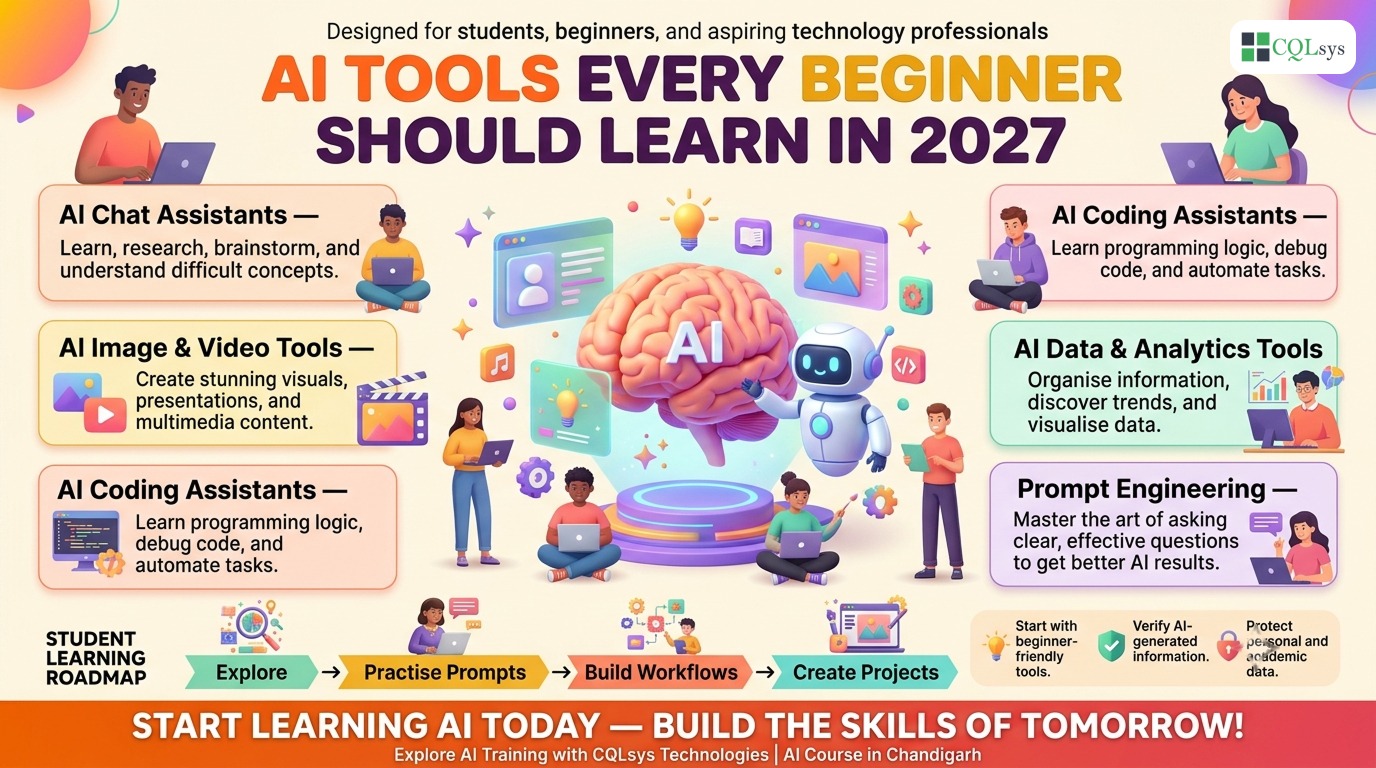
AI Tools Every Beginner Should Learn in 2027
The rapid acceleration of artificial intelligence has fundamentally shifted how individuals and enterprises approach daily workflows, problem-solving, and continuous education. For newcomers entering this technological domain, the primary challenge is not finding software, but filtering through an overwhelming array of options to identify the best AI tools for beginners. Whether you are a student preparing for a technology-driven workforce, a professional seeking workflow automation, or an aspiring developer evaluating structured learning paths, mastering the right foundational applications is essential. This guide examines the core artificial intelligence tools that matter, practical use cases, and how structured programs like an AI course in Chandigarh bridge the gap between basic familiarity and professional competency.
Why Understanding Foundational Artificial Intelligence Tools Matters
As automation permeates every major industry, digital literacy now encompasses more than basic computer navigation. It requires a working knowledge of how intelligent systems process data, generate content, and assist with complex decision-making. Novices often feel intimidated by advanced machine learning models, yet modern platforms abstract underlying complexities behind intuitive user interfaces.
By familiarizing yourself with accessible artificial intelligence tools, you develop critical computational thinking skills. Instead of viewing technology as a black box, learners begin to understand prompt formulation, data structuring, and output evaluation. This foundational knowledge serves as a stepping stone toward advanced disciplines such as software development and enterprise automation.
Categorizing the Essential AI Tools for Newcomers
To build a balanced skill set, beginners should explore software across several functional categories. Each category addresses specific operational needs, ranging from creative composition to analytical problem-solving.
1. Conversational Assistants and Knowledge Retrieval
Conversational platforms act as interactive tutors, research assistants, and brainstorming partners. These systems utilize advanced language models to synthesize information, explain complex topics, and draft text based on natural language instructions. Learning how to formulate precise prompts allows users to extract accurate, context-aware insights quickly.
2. Visual and Multimedia Generation Software
Visual AI applications allow users to create images, diagrams, and video concepts through descriptive text prompts. For students and digital marketers, these tools accelerate content creation and visual communication without requiring advanced graphic design expertise.
3. Automated Coding and Logic Assistants
Even without formal programming experience, beginners can utilize AI-driven coding assistants to understand logic flows, debug simple scripts, and automate repetitive tasks. These platforms demystify software development, making technical concepts approachable for non-engineers.
4. Data Organization and Analytical Assistants
Spreadsheet automation and data visualization tools powered by machine learning help users clean datasets, identify trends, and generate automated summaries. This category empowers business professionals to make data-driven decisions without manual statistical analysis.
Practical Applications for Students and Professionals
Integrating intelligent software into daily routines transforms passive learning into active productivity. Consider how different user groups leverage these technologies:
- Students: Utilizing conversational models for concept clarification, automated summarization of academic papers, and interactive language practice.
- Working Professionals: Employing text generators for professional correspondence, scheduling automation, and market research synthesis.
- Aspiring Technologists: Testing no-code automation platforms to understand system workflows before enrolling in an immersive AI course in Chandigarh.
High-Level Solution Architecture: How AI Learning Ecosystems Operate
Understanding how software applications interact with underlying models helps demystify user-facing interfaces. Below is an architectural overview illustrating how user requests travel through modern AI platforms:
User Layer → Experience & Interface Layer → Security & Authentication Layer → API Gateway & Request Router → Core AI Processing Engine → Data & Knowledge Retrieval Layer → Response Generation & Output Formatting
- User Layer (Students / Beginners) — Initiates queries, prompts, or interaction requests.
- Experience & Interface Layer (Web / Mobile App Dashboards) — Renders the visual workspace and chat interface for seamless navigation.
- Security & Authentication Layer (Access Control & Token Management) — Enforces security, user verification, and token rate limits.
- API Gateway & Request Router — Directs user inputs to the appropriate internal services and machine learning models.
- Core AI Processing Engine (Language Models & Machine Learning Services) — Executes inference and generates output using natural language processing algorithms.
- Data & Knowledge Retrieval Layer (Vector Databases & External Repositories) — Supplies context and retrieves relevant factual data to enhance accuracy.
- Response Generation & Output Formatting — Formats the response and delivers it back to the client interface.
Explanation of Architecture Layers
- User Layer: Represents the student, professional, or beginner interacting with the software via a web browser or mobile device.
- Experience & Interface Layer: Provides the visual dashboard, chat window, or file upload interface designed for ease of use.
- Security & Authentication Layer: Manages user credentials, session tokens, and data privacy controls to ensure secure interaction.
- API Gateway & Request Router: Directs incoming user prompts to the appropriate processing pipeline or model endpoint.
- Core AI Processing Engine: Executes inference, analyzing natural language or visual inputs to generate intelligent responses.
- Data & Knowledge Retrieval Layer: Supplies external context, documentation, or domain-specific knowledge to enhance response accuracy.
Technology Stack and Comparison
Selecting the right tools involves understanding the underlying capabilities and intended use cases. The table below compares traditional software approaches with modern AI-driven solutions.
| Feature Area | Traditional Software Approach | Modern AI-Driven Solution |
|---|---|---|
| User Interaction | Rigid menus, forms, and strict command syntax | Natural language prompts and conversational interfaces |
| Data Processing | Manual sorting, rule-based filtering, and static queries | Dynamic pattern recognition and semantic search |
| Learning Curve | High technical barrier requiring extensive software training | Intuitive interfaces designed for rapid onboarding |
| Adaptability | Fixed functionality requiring manual updates for new rules | Continuous learning through updated models and context |
| Primary Benefit | Deterministic and predictable operational execution | Accelerated productivity and creative problem-solving |
For those looking to move beyond basic tool usage and build custom applications, exploring structured options such as an AI training institute in Chandigarh provides hands-on exposure to robust development stacks.
Cost, ROI, and Personal Development Impact
Investing time and resources into mastering modern technology yields significant long-term benefits.
- Time Efficiency: Beginners save hours on research, drafting, and data organization by automating repetitive tasks.
- Skill Monetization: Professionals who master intelligent software increase their value in the job market, opening doors to higher-paying roles and leadership opportunities.
- Educational Acceleration: Students grasp complex subjects faster when utilizing interactive tutoring platforms tailored to their learning pace.
While many foundational tools offer free tiers, transitioning to professional-grade platforms or formal AI training in Chandigarh involves nominal investment that pays dividends through enhanced career mobility.
Security, Privacy, and Responsible Usage
As beginners engage with digital platforms, maintaining robust security practices is critical. Users must exercise caution when inputting sensitive personal data, proprietary business information, or confidential academic research into public software.
- Data Governance: Understand platform privacy policies regarding whether user inputs are utilized for model training.
- Authentication Security: Implement strong passwords and multi-factor authentication across all software accounts.
- Critical Evaluation: Maintain healthy skepticism regarding AI-generated outputs, verifying factual claims through authoritative secondary sources.
Implementation Roadmap: Your Learning Journey
Transitioning from absolute novice to proficient user requires a structured, step-by-step approach:
- Phase 1 — Exploration & Familiarization: Discovering basic chat and productivity tools to understand foundational capabilities.
- Phase 2 — Prompt Engineering Mastery: Learning how to structure precise instructions to improve AI response accuracy.
- Phase 3 — Workflow Integration: Applying software to daily study or work tasks to automate administrative workflows.
- Phase 4 — Structured Education: Enrolling in a professional AI course in Chandigarh to acquire in-depth skill sets.
- Phase 5 — Advanced Application & Specialization: Building custom software solutions, automation pipelines, or domain-specific projects.
- Discovery: Experiment with free conversational and productivity applications to understand core capabilities.
- Experimentation: Practice crafting specific prompts to observe how subtle wording changes affect output quality.
- Integration: Embed software assistants into daily routines for drafting, summarizing, and brainstorming.
- Formal Education: Pursue structured artificial intelligence training in Chandigarh to deepen technical understanding.
- Project Execution: Build personal projects or automate routine administrative tasks to solidify practical competence.
Why Choose CQLsys Technologies?
As organizations accelerate their digital transformation initiatives, partnering with an experienced technology provider ensures seamless execution. CQLsys Technologies delivers enterprise-grade software development, comprehensive artificial intelligence solutions, and custom software development services tailored to diverse business requirements. By combining deep technical expertise with agile delivery methodologies, CQLsys helps businesses build scalable, high-performance digital ecosystems. Whether you require bespoke enterprise applications or expert IT consulting, our team bridges the gap between complex technological capabilities and measurable business outcomes.
10 SEO FAQs
1. What are the best AI tools for beginners to start with?
Beginners should start with accessible conversational assistants, basic text generation platforms, and user-friendly automation tools. These applications feature intuitive interfaces that require no prior coding experience, allowing newcomers to understand prompt formulation, content synthesis, and basic digital workflow optimization effectively.
2. How can students benefit from artificial intelligence tools?
Students leverage intelligent software for rapid research synthesis, concept clarification, language learning, and essay outlining. These tools act as personalized tutors, helping learners grasp difficult academic subjects faster while improving writing clarity and overall study efficiency.
3. Do I need coding experience to use modern AI tools?
No coding experience is required to use most modern software assistants. The vast majority of consumer and professional applications utilize natural language interfaces, enabling users to interact with advanced machine learning models simply by typing plain-language instructions.
4. Where can I find a reliable AI course in Chandigarh?
Finding a comprehensive educational program involves looking for institutes that offer hands-on training, experienced instructors, and practical project work. A structured AI course in Chandigarh helps learners bridge the gap between theoretical knowledge and practical software application.
5. Which AI tools are free for everyday productivity?
Many prominent conversational assistants, image generation platforms, and note-taking applications offer robust free tiers. These free versions provide sufficient capability for beginners to learn prompt engineering, experiment with workflow automation, and evaluate software suitability without financial commitment.
6. How do generative AI applications process natural language?
Generative applications utilize complex neural networks trained on vast datasets of text. When a user submits a prompt, the underlying model predicts and generates statistically probable sequences of words or data points to produce coherent, contextually relevant responses.
7. What is the difference between AI assistants and machine learning models?
An AI assistant is a user-facing software application designed to perform specific tasks, whereas a machine learning model is the underlying algorithmic engine that processes data and learns patterns. Assistants utilize these models to execute intelligent functions for end-users.
8. How can beginners transition into structured artificial intelligence training?
Novices can transition by moving from casual tool usage to formal educational programs. Enrolling in specialized artificial intelligence training in Chandigarh introduces students to foundational algorithms, data preprocessing, and professional development methodologies.
9. Why is prompt engineering crucial for mastering AI tools?
Prompt engineering is the practice of structuring clear, specific instructions for software models. Mastering this skill ensures users receive accurate, relevant, and high-quality outputs, significantly reducing trial-and-error time when interacting with advanced digital platforms.
10. How does CQLsys Technologies support custom AI implementation?
CQLsys Technologies assists enterprises by designing and deploying custom artificial intelligence solutions, integrating intelligent workflows, and building robust software development pipelines. Our expert team ensures seamless technological integration aligned with specific organizational growth objectives.
Transform your digital capabilities with expert guidance and custom technological solutions. Whether you are looking to integrate intelligent automation into your enterprise or explore innovative software development strategies, our team is ready to assist. Contact us today to discuss your project requirements with our senior consultants.