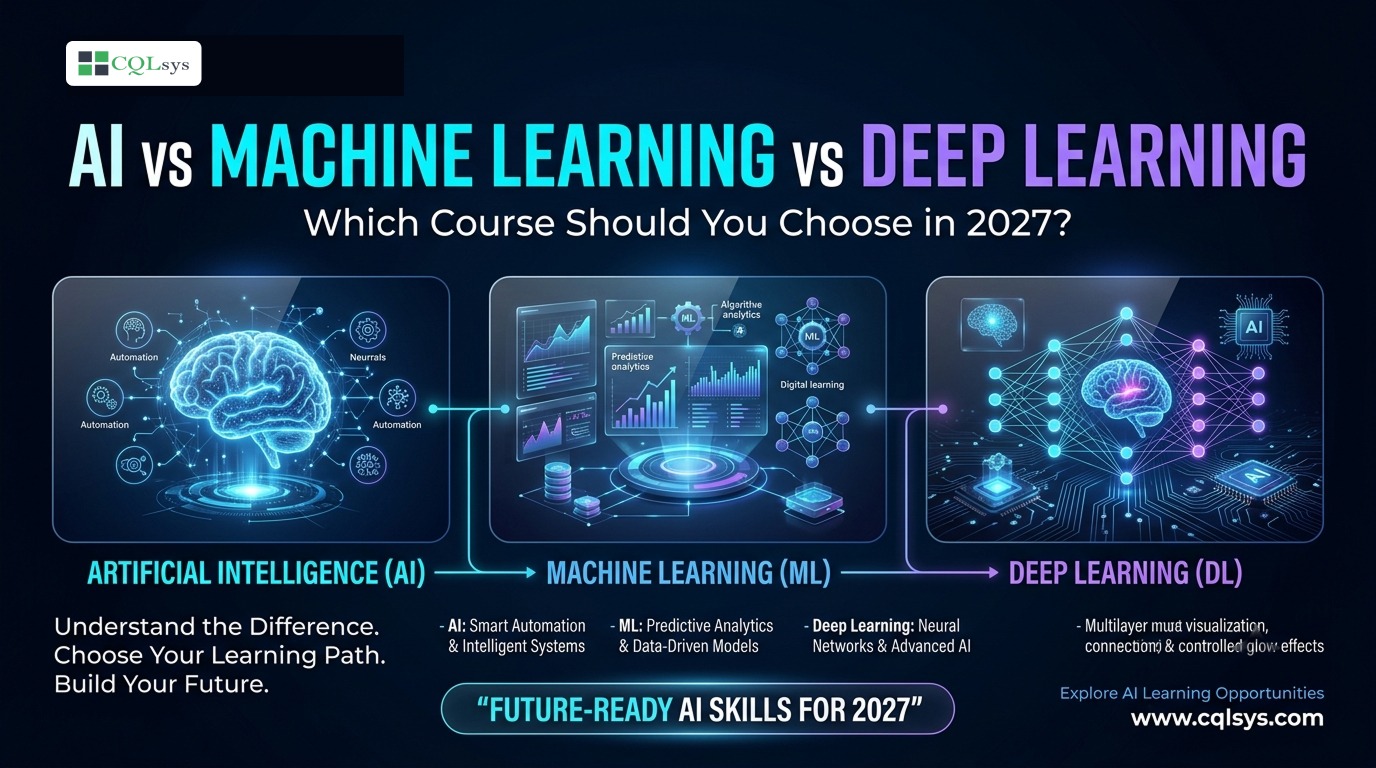
AI vs Machine Learning vs Deep Learning: Which Course Should You Choose in 2027?
Introduction
The rapid expansion of computational intelligence across global enterprises has created an unprecedented demand for specialized talent. Professionals aiming to future-proof their careers often face a complex dilemma when reviewing the educational landscape. The core question remains: AI vs Machine Learning vs Deep Learning: Which Course Should You Choose in 2027? Selecting the appropriate curriculum requires more than scanning popular course titles; it demands a clear understanding of how artificial intelligence foundations, machine learning certification path structures, and deep learning training programs intersect with modern business requirements.
As organizations accelerate their adoption of intelligent automation, data science, and predictive analytics, educational choices dictate career trajectories. Whether you are an enterprise leader, an aspiring developer, or a technology strategist, understanding the nuances between these disciplines ensures that your time and financial investment yield maximum professional return. This article examines the structural differences, career outcomes, and strategic considerations required to make an informed decision.
Core Differences Between AI, ML, and Deep Learning
To select the correct learning path, you must first establish the hierarchical relationship among these three domains. Artificial intelligence represents the broad umbrella concept, machine learning serves as a subset focused on data-driven adaptation, and deep learning functions as a specialized subset of machine learning utilizing multi-layered neural networks.
| Discipline | Core Focus | Primary Mechanism | Typical Business Application |
|---|---|---|---|
| Artificial Intelligence | Simulating human reasoning | Rule-based systems, logic, algorithms | Customer service chatbots, automation workflows |
| Machine Learning | Learning from historical data | Statistical models, regression, classification | Predictive maintenance, churn prediction |
| Deep Learning | Complex pattern recognition | Artificial neural networks, high-dimensional data | Computer vision, natural language processing |
Examining this hierarchy reveals that artificial intelligence encompasses a wide spectrum of problem-solving techniques, ranging from simple automated logic to advanced autonomous agents. Machine learning shifts the paradigm from hard-coded rules to algorithmic learning, allowing systems to improve performance as they ingest more data. Deep learning further refines this capability by processing unstructured data through complex network architectures that mimic biological neural pathways.
Understanding Artificial Intelligence Foundations
Courses centered on broad artificial intelligence concepts provide a holistic overview of how smart systems operate within enterprise environments. These programs typically avoid heavy mathematical formulas in favor of conceptual mastery, system integration, and strategic deployment.
Students learn how artificial intelligence interacts with Custom Software Development to solve operational inefficiencies. The curriculum usually covers natural language processing basics, computer vision applications, and the ethical considerations surrounding automated decision-making. Choosing an artificial intelligence foundation course suits business leaders, product managers, and consultants who require a comprehensive view of technology capabilities without needing to build models from scratch.
Machine Learning: Bridging Theory and Practical Application
Machine learning courses form the backbone of modern data-driven enterprises. These programs bridge the gap between abstract theoretical mathematics and practical software engineering. Learners explore supervised, unsupervised, and reinforcement learning techniques, gaining the ability to transform raw corporate data into actionable intelligence.
A robust machine learning curriculum emphasizes data preprocessing, feature engineering, and model evaluation metrics. Professionals who complete these programs typically transition into roles where they build predictive models for finance, retail, and logistics. Integrating these capabilities often requires robust Artificial Intelligence Services to ensure models scale efficiently across cloud infrastructure.
Deep Learning: Mastering Neural Networks and Advanced Computing
Deep learning training programs represent the most technically rigorous tier of computational education. Designed for individuals with a strong foundation in linear algebra, calculus, and programming concepts, these courses dive deep into neural network architectures.
Participants study convolutional neural networks for image analysis, recurrent networks for sequential data, and transformer models that power modern generative technologies. Because these systems demand immense computational power, courses in this category often touch upon cloud resource management and hardware acceleration. Mastering deep learning prepares engineers to tackle complex problems that traditional algorithms cannot solve, such as real-time language translation and autonomous navigation.
Evaluating Your Career Goals and Technical Readiness
Determining the right course for 2027 depends heavily on your current skill set, professional background, and long-term career aspirations. Aligning your educational investment with market demand ensures sustainable growth.
Professional progression flows from evaluating your background to assessing skills, verifying technical readiness, selecting the targeted course, and finally applying knowledge to enterprise environments.
Strategic Career Alignment
- Business Leaders and Strategists: Benefit most from broad artificial intelligence overviews that emphasize strategic integration and ROI.
- Software Engineers and Analysts: Find success in machine learning paths that enhance existing application development capabilities with predictive modeling.
- Data Scientists and Research Engineers: Require deep learning programs to push the boundaries of unstructured data processing and neural architecture design.
High-Level Solution Architecture for AI Training and Deployment
Implementing educational concepts in a professional environment requires a structured technological framework. Organizations building internal capabilities or deploying AI solutions rely on a multi-layered architecture where learners and users access experience portals connected via security protocols and API gateways to AI processing layers and underlying data lakes.
Architecture Components Explained
- User & Experience Layer: Portals, dashboards, and interactive learning management systems where students or enterprise teams access training modules and model interfaces.
- Security Layer: Identity management, access control protocols, and secure authentication mechanisms ensuring data privacy across learning environments.
- Application & API Layer: Manages incoming requests, service routing, and communication between user interfaces and backend computational engines.
- AI & ML Processing Layer: Houses the underlying algorithms, neural network frameworks, and model training pipelines.
- Data Layer: Secure repositories, cloud databases, and data lakes storing training datasets, user progress metrics, and enterprise telemetry.
Cost, ROI, and Business Impact
Investing in advanced technology education involves evaluating direct financial outlays against long-term professional returns. While comprehensive deep learning or machine learning certifications require significant time and financial commitment, the resulting career advancement and organizational efficiency drive substantial ROI.
Enterprises upskilling their engineering teams experience accelerated digital transformation, reduced reliance on external consultants, and faster deployment of proprietary intelligent applications. Evaluating cost factors involves looking at tuition fees, hardware requirements for local training, and cloud computing resources needed to practice model training effectively.
Security, Compliance, and Responsible AI
As intelligent systems become pervasive, security and regulatory compliance remain paramount. Educational programs must incorporate best practices in data governance, privacy protection, and ethical AI development.
Professionals learning to build and deploy models must understand data anonymization, bias mitigation, and regulatory frameworks governing automated decision-making. Ensuring that models operate transparently protects organizations from liability and maintains user trust across international markets.
Implementation Roadmap for Upskilling in 2027
Adopting a structured roadmap ensures that individuals and organizations maximize the value of their chosen educational path.
- Phase 1 — Assessment: Evaluate current technical competencies, mathematical proficiency, and organizational objectives.
- Phase 2 — Selection: Choose between broad artificial intelligence, practical machine learning, or advanced deep learning curricula based on career goals.
- Phase 3 — Foundational Study: Master core mathematical principles, data handling techniques, and introductory algorithmic logic.
- Phase 4 — Practical Application: Engage in hands-on projects, building models and integrating solutions through Web Development and mobile platforms.
- Phase 5 — Enterprise Integration: Apply learned methodologies to real-world business challenges, focusing on scalability and performance optimization.
- Phase 6 — Continuous Optimization: Monitor emerging technological shifts, update skill sets, and refine deployed models regularly.
Why Choose CQLsys Technologies?
Navigating the complexities of artificial intelligence integration requires an experienced technology partner. CQLsys Technologies delivers enterprise-grade solutions tailored to modern business requirements. Combining deep industry expertise with agile development practices, our teams help organizations design, build, and scale intelligent software systems efficiently.
Whether you are looking to integrate machine learning models into existing platforms or embark on a comprehensive digital transformation journey, our specialists provide the technical backbone required for success. Discover more about our capabilities by visiting our About Us page or exploring our complete suite of Services. For those seeking specialized training or development in the region, you can also explore our dedicated AI course in Chandigarh to accelerate your technical proficiency.
10 SEO FAQs
1. Which course is best for beginners in AI?
Beginners should start with foundational artificial intelligence courses that focus on concepts, use cases, and strategy without requiring advanced coding. These programs establish a solid understanding before progressing to technical machine learning or deep learning paths. Reviewing options like an AI course in Chandigarh can provide structured guidance for newcomers entering the field.
2. Do I need programming experience for deep learning courses?
Yes, deep learning courses typically require strong proficiency in programming languages like Python, alongside a solid grasp of linear algebra and calculus. Because these programs involve building and tuning complex neural networks, prior experience with machine learning frameworks is essential for success.
3. What is the difference between machine learning and deep learning?
Machine learning is a broader subset of artificial intelligence that relies on algorithms to parse data, learn from it, and make informed decisions. Deep learning is a specialized branch of machine learning utilizing multi-layered artificial neural networks to handle highly complex unstructured data like images and natural language.
4. How much does an artificial intelligence certification cost in 2027?
Certification costs vary widely depending on the institution, depth of curriculum, and practical project requirements. Programs range from affordable online modules to intensive enterprise bootcamps. Investing in recognized training paths through institutions offering specialized tracks, such as an AI course in Chandigarh, ensures comprehensive skill acquisition aligned with market standards.
5. Are AI courses in Chandigarh worth the investment?
Regional training programs provide localized mentorship, networking opportunities, and practical project experience that align with growing technological hubs. Enrolling in a reputable program like an AI course in Chandigarh equips professionals with competitive skills demanded by global enterprises and local IT firms alike.
6. Which industries value machine learning expertise the most?
Finance, healthcare, retail, logistics, and telecommunications place exceptionally high value on machine learning expertise. Organizations in these sectors leverage predictive models for fraud detection, personalized customer experiences, supply chain optimization, and automated risk assessment.
7. How long does it take to complete a deep learning program?
Comprehensive deep learning programs typically require three to nine months of dedicated study, depending on the student's background and the intensity of the curriculum. Mastering neural networks, optimization techniques, and practical framework implementation demands consistent, hands-on practice.
8. Is mathematics required for artificial intelligence courses?
While high-level overview courses require minimal mathematics, technical machine learning and deep learning paths demand a working knowledge of statistics, probability, linear algebra, and calculus. These mathematical foundations are crucial for understanding how algorithms learn and optimize performance.
9. How does an AI course help in career advancement?
Completing specialized training validates your technical competence, enabling you to transition into high-demand roles such as machine learning engineer, data scientist, or AI solution architect. Organizations actively seek certified professionals who can bridge the gap between complex algorithms and commercial business value.
10. Where can I find professional guidance for AI integration?
Organizations seeking to implement intelligent solutions or upskill internal teams can partner with established technology consultants. Exploring tailored solutions through an AI course in Chandigarh or consulting with enterprise experts ensures your technology initiatives achieve optimal performance and measurable ROI.
Strategic CTA
Ready to transform your enterprise capabilities with advanced intelligence or accelerate your technical expertise? Partner with industry leaders to build scalable, high-performance solutions tailored to your business objectives. Contact CQLsys Technologies today at https://www.cqlsys.com/contact-us to schedule a consultation with our technology architects and discover how our specialized AI course in Chandigarh can elevate your professional journey.