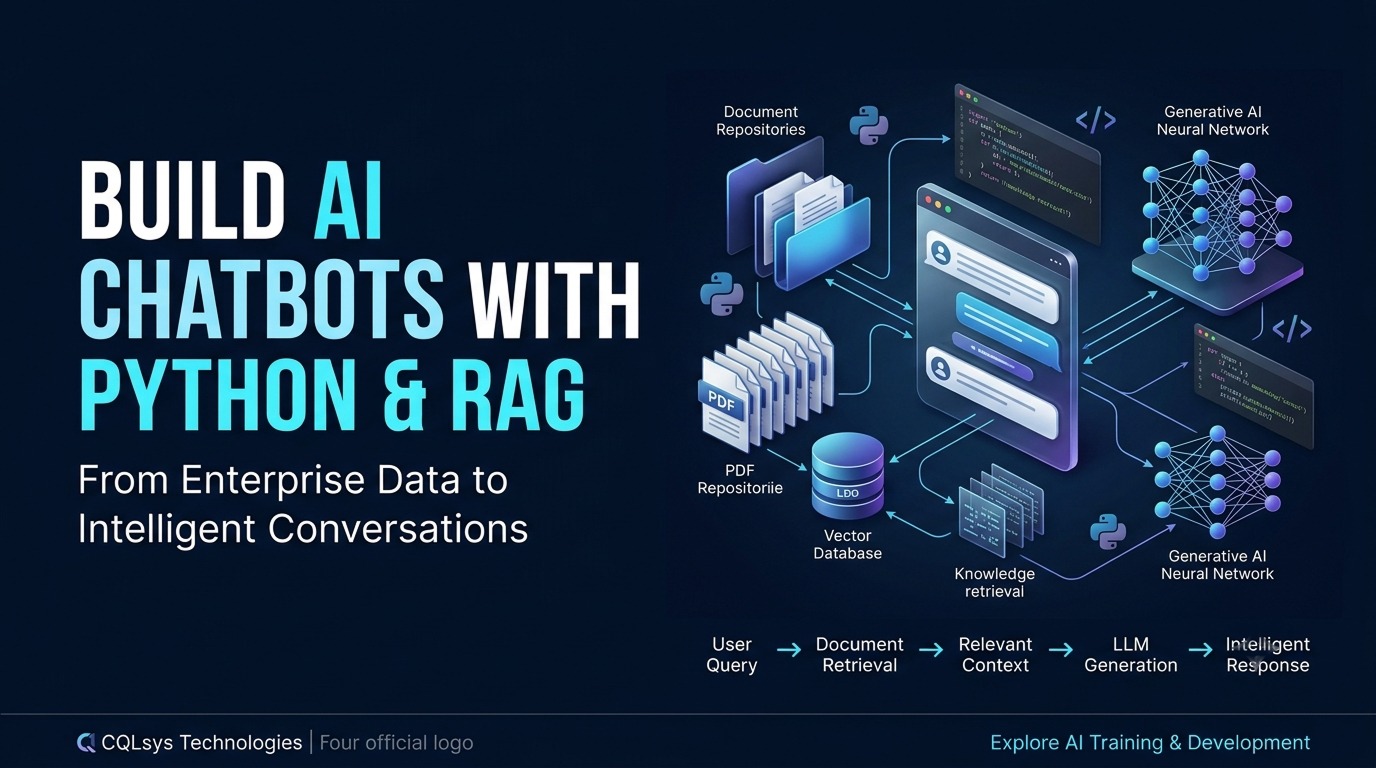
How to Build a Generative AI Chatbot Using Python and RAG
Organizations are increasingly looking to deploy conversational systems that move beyond generic responses to deliver precise, context-aware business insights. To achieve this, enterprises must move past basic prompt engineering and adopt robust frameworks that combine large language models with proprietary data sources. When companies explore how to build an AI chatbot using Python and RAG, they establish a secure foundation for scalable, enterprise-grade AI integration.
This comprehensive guide explores the architectural blueprints, foundational technologies, and strategic implementation methodologies required to construct high-performing conversational systems using Retrieval-Augmented Generation. Whether you are scaling internal knowledge management portals or customer-facing support agents, mastering this technical stack is critical for modern digital transformation. For professionals seeking hands-on mastery of these technologies, enrolling in an AI course in Chandigarh provides the practical skills necessary to lead enterprise artificial intelligence initiatives.
The Evolution of Conversational AI: Why RAG Matters
Traditional chatbots rely strictly on pre-scripted rule trees or static knowledge bases, resulting in rigid user interactions. While early large language models offered broader conversational abilities, they suffered from critical limitations: static training cutoffs, lack of domain-specific context, and a tendency to hallucinate incorrect facts.
Retrieval-Augmented Generation resolves these vulnerabilities by splitting knowledge retrieval from text generation. Instead of forcing the language model to memorize proprietary enterprise data, the system queries an external vector database containing company documents, manuals, or transaction logs. The most relevant text chunks are then injected directly into the prompt context, allowing the language model to synthesize an accurate, verifiable answer grounded strictly in verified data.
Core Advantages of Retrieval-Augmented Generation
- Enhanced Accuracy: Grounds model responses in factual enterprise documents, drastically reducing hallucinations.
- Dynamic Updates: Allows real-time document ingestion without requiring costly model retraining cycles.
- Data Security: Keeps proprietary operational records securely isolated within internal databases.
- Traceability: Enables system auditors to trace generated answers directly back to source documents.
High-Level Solution Architecture
Designing a production-ready conversational assistant requires a structured multi-layered architecture that ensures secure user interactions, efficient vector search, and reliable language model orchestration.
Users → Web/Mobile Application → Security Layer → API Gateway → Application Services Layer → Orchestration Engine → Vector Database + LLM Provider → Response Delivery
Architectural Component Breakdown
- User & Experience Layer: The interface through which users interact with the system, ranging from web-based customer portals to internal enterprise dashboards.
- Security & Authentication Layer: Manages identity verification, role-based access control, and API rate-limiting via managed cloud security providers.
- Application Services Layer: Built using robust software development standards, this layer handles incoming queries, user session management, and asynchronous request queuing.
- Orchestration & RAG Engine: The core workflow manager that coordinates query expansion, semantic embedding generation, vector similarity searches, and prompt construction.
- Data & Vector Layer: Combines relational databases for user management with specialized vector storage engines designed for high-speed similarity matching.
Technical Stack for Python-Based Conversational Systems
Selecting the correct technology stack determines the long-term scalability, maintenance overhead, and inference latency of your conversational platform. Python remains the undisputed language of choice for machine learning and natural language processing due to its rich ecosystem of libraries and frameworks.
| Layer | Purpose | Suitable Technologies |
|---|---|---|
| Frontend Interface | User interaction and real-time chat rendering | React, Next.js, Tailwind CSS |
| Backend Orchestration | API endpoints and business logic handling | Python, FastAPI, Django |
| LLM Orchestration | Managing prompt templates and retrieval chains | LangChain, LlamaIndex |
| Vector Database | Storing and querying high-dimensional embeddings | Pinecone, Chroma, Milvus, PostgreSQL with pg vector |
| Cloud Infrastructure | Scalable hosting and container deployment | AWS, Docker, Kubernetes |
For businesses aiming to scale their technical capabilities, partnering with experts in custom software development ensures that your technology stack is optimized for enterprise performance and seamless third-party integrations.
Implementation Roadmap for Enterprise Deployment
Successfully deploying a production-grade conversational system requires a disciplined, multi-phase engineering approach that minimizes risk and validates system accuracy at every stage.
Phase 1 — Discovery & Requirements Gathering
Define the primary use cases, target audience expectations, latency requirements, and compliance boundaries. Establish clear success metrics, such as retrieval accuracy and user satisfaction scores.
Phase 2 — Data Pipeline & Ingestion Strategy
Collect, clean, and chunk proprietary enterprise documentation. Establish automated pipelines that convert unstructured text into high-dimensional vector embeddings stored securely within your chosen vector database.
Phase 3 — Orchestration & Prompt Engineering Design
Configure the orchestration framework to manage semantic search parameters, similarity thresholds, and contextual prompt templates that prevent model drift and ensure tone consistency.
Phase 4 — Security, Privacy, and Access Control Integration
Implement robust data masking, encryption standards, and role-based access permissions to ensure that users only retrieve information they are authorized to view.
Phase 5 — Performance Testing & Evaluation
Test the system against known test datasets to measure retrieval precision, answer relevance, generation speed, and system resilience under peak load conditions.
Phase 6 — Production Deployment & Continuous Monitoring
Launch the application into a containerized cloud environment. Continuously monitor token usage, inference costs, and user feedback loops to drive ongoing optimization.
Security, Privacy, and Governance Considerations
Enterprise deployments of generative AI systems demand rigorous security protocols to protect sensitive intellectual property and maintain regulatory compliance.
- Data Encryption: Ensure all documents, vector embeddings, and API payloads are encrypted both in transit and at rest using industry-standard protocols.
- Access Governance: Restrict retrieval operations so that user permissions are validated before vector searches are executed against the knowledge base.
- Hallucination Mitigation: Implement guardrails and secondary verification steps to flag unverified assertions before output is rendered to the user.
- Compliance Alignment: Adhere to regional data privacy frameworks such as GDPR or HIPAA depending on the industry vertical and geographic market.
Why Choose CQLsys Technologies?
Organizations embarking on complex digital transformation initiatives require experienced technical partners who understand both high-level business strategy and intricate software engineering. CQLsys Technologies delivers end-to-end expertise across artificial intelligence, cloud computing, and custom software development.
Our dedicated engineering teams work closely with enterprise stakeholders to design scalable architectures, build secure data pipelines, and deploy production-grade applications that drive measurable ROI. Whether you are launching your first generative AI initiative or modernizing legacy enterprise systems, our proven methodologies ensure robust execution from discovery to deployment. Explore our comprehensive service offerings on our services page or learn more about our company history.
Frequently Asked Questions
What are the prerequisites for building an AI chatbot using Python and RAG?
Building a production-ready RAG chatbot requires foundational proficiency in Python programming, an understanding of RESTful APIs, familiarity with vector mathematics or embeddings, and basic knowledge of cloud infrastructure. Additionally, teams must have structured document repositories ready for ingestion and processing.
How does Retrieval-Augmented Generation improve LLM accuracy?
Retrieval-Augmented Generation improves accuracy by fetching precise, verified documents from an external vector database and inserting them directly into the language model prompt. This grounds the generated response in factual enterprise data, eliminating speculative hallucinations and ensuring verifiable outputs.
Which vector database is best for Python RAG applications?
The choice of vector database depends on your scaling requirements, latency constraints, and existing infrastructure. Popular options include Pinecone for fully managed cloud scaling, Chroma for lightweight local development and prototyping, and PostgreSQL with the pgvector extension for teams preferring relational database consolidation.
Can RAG systems be updated in real-time without retraining models?
Yes, one of the primary benefits of a RAG architecture is that knowledge bases can be updated instantaneously. When new documents are added or existing records modified, the ingestion pipeline simply generates new embeddings and updates the vector database without requiring any model fine-tuning.
How do you secure enterprise data within a generative AI chatbot?
Enterprise data security is maintained by implementing strict role-based access control, encrypting data both in transit and at rest, applying data masking techniques, and ensuring that vector similarity searches only query documents the authenticated user has explicit permission to view.
What is the role of orchestration frameworks like LangChain in RAG?
Orchestration frameworks simplify the process of chaining together different components of an AI application. They manage document loaders, text splitters, embedding models, vector store connectors, and language model prompts, allowing developers to build complex workflows with minimal boilerplate code.
How are document chunks optimized for better retrieval performance?
Document chunking strategies involve splitting large text files into smaller, semantically coherent segments, often with overlapping boundaries. This ensures that specific contextual details are preserved and that vector similarity searches retrieve precise paragraphs rather than overly broad documents.
What are the primary cost factors when deploying an enterprise AI chatbot?
Primary cost factors include API token consumption from the underlying language model provider, vector database storage and query fees, cloud infrastructure hosting expenses, and ongoing engineering maintenance required to monitor system performance and update knowledge bases.
How do you handle user session history in a conversational AI system?
User session history is typically managed by maintaining a conversational buffer memory within the application layer. This history is appended to incoming queries so the language model maintains context across multi-turn dialogues without losing track of user intent.
How can professionals get started with AI development training in Chandigarh?
For professionals looking to build practical expertise in machine learning and natural language processing, exploring structured training programs such as the AI course in Chandigarh offered by industry leaders provides comprehensive hands-on guidance and real-world project experience.
Ready to accelerate your business growth with advanced generative AI solutions and custom enterprise software? Connect with our technical consultants today to discuss your project requirements and discover how our engineering expertise can bring your vision to life. Visit our contact page to schedule a discovery consultation with our team.