Machine Learning for Retail Companies in London: Turning Customer Data into Better Customer Experiences
Introduction: The New Battleground for Retail in London
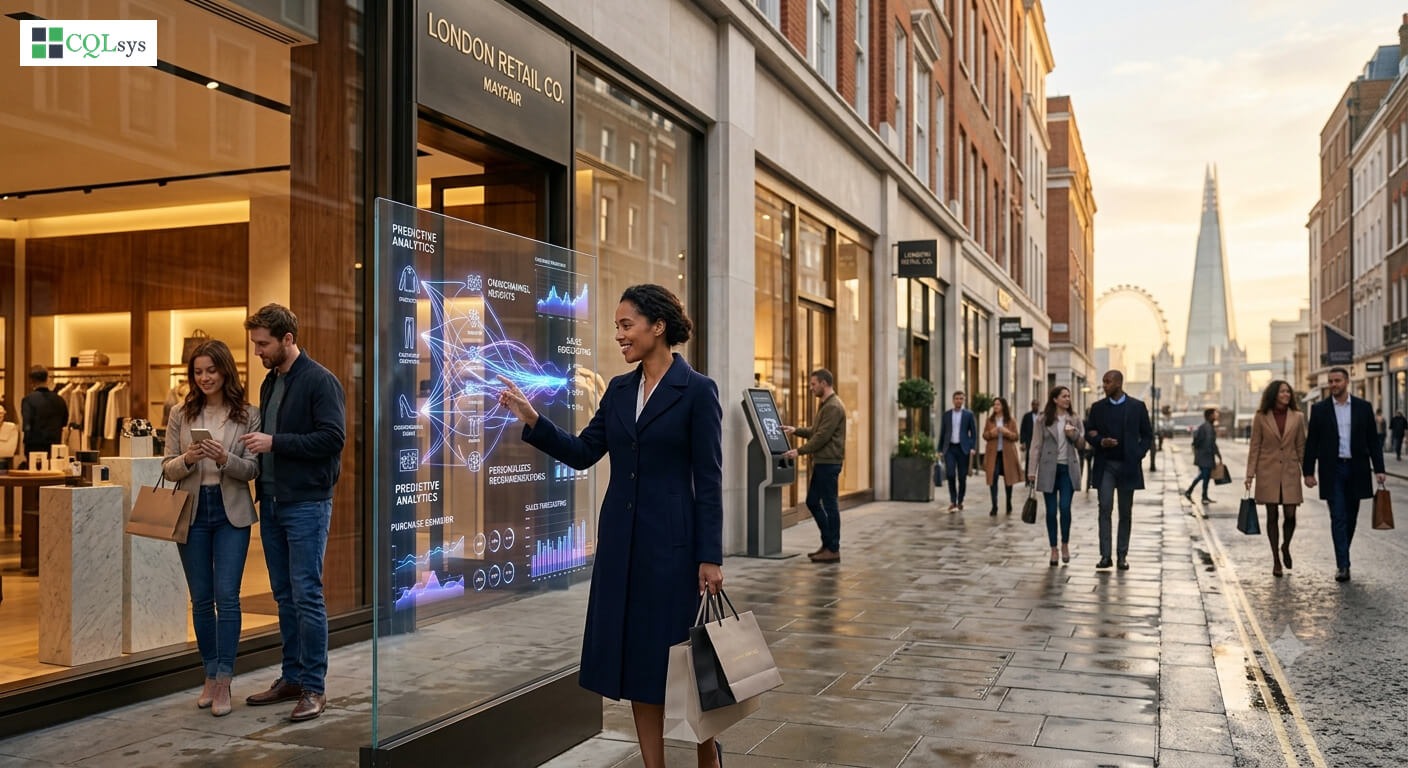
London remains one of the world's most competitive, fast-moving retail capitals. From iconic brick-and-mortar storefronts on Regent Street and Mayfair to hyper-agile digital brands operating across Greater London, consumer expectations are higher than ever. Modern shoppers demand instant product availability, curated recommendations, frictionless checkout, and contextual interactions across physical and online touchpoints.
However, many British retailers are sitting on vast reserves of unexploited customer data. Point-of-Sale (POS) transactions, mobile app interactions, web browsing habits, loyalty program engagements, and supply chain telemetry are often siloed across legacy platforms. Without intelligent processing, this data remains static noise rather than an operational asset.
- RAW CUSTOMER DATA
(POS Logs, App Clicks, Loyalty Records, Web Browsing, Inventory) - MACHINE LEARNING PIPELINE
(Cleansing, Feature Engineering, Segmentation, Pattern Analytics) - HYPER-PERSONALIZED EXPERIENCES
(1:1 Product Feeds, Dynamic Pricing, Smart Stocking, Instant Chat)
This is where Machine Learning for Retail Companies in London transforms passive data into proactive, personalized experiences. According to recent UK market insights, machine learning holds over 40% of the UK AI retail market share, driving demand forecasting, recommendation engines, and customer lifetime value optimization. Retailers deploying machine learning algorithms achieve faster growth and healthier gross margins by reducing stockouts, lowering customer acquisition costs (CAC), and increasing repeat purchases.
Partnering with an experienced partner like CQLsys Technologies allows high-street brands and digital pure-play retailers in London to harness tailored algorithms that convert complex data streams into quantifiable business growth.
Industry Overview: Why London Retailers Are Doubling Down on ML
The UK AI in the retail market is projected to reach several billion dollars over the coming decade, with London serving as the primary hub for technology adoption and venture investment. London's diverse demographics and high density of multi-channel retailers make it an ideal testbed for algorithmic commerce.
Performance Comparison: ML Adopters vs. Traditional Retailers
| Metric / Focus | ML-Driven Retailers | Traditional Retailers |
|---|---|---|
| Inventory Forecast Accuracy | 30% higher accuracy via real-time signal tracking | Dependent on historical, static seasonal baselines |
| Demand Response Speed | Real-time adjustments based on local demand | Delayed weekly or monthly manual revisions |
| Fulfillment Efficiency | Optimized routing, reducing last-mile costs | Fixed zone logistics with higher fuel overheads |
When retailers move from basic rules-based analytics to predictive machine learning models, they eliminate blind spots in buyer behavior. Whether anticipating seasonal surges in Westfield White City or optimizing localized delivery routes across South London, ML provides real-time decision support that legacy IT frameworks simply cannot deliver.
Current Challenges Facing London Retailers
Retailers in Greater London face distinct operational and market headwinds that make manual data management impossible:
- Data Fragmentation Across Channels: In-store POS terminals, e-commerce stores, and social channels store customer interactions in separate databases.
- Rapidly Shifting Consumer Preferences: Macroeconomic pressures and social media trends cause sudden demand fluctuations that traditional replenishment models miss.
- High Operational Costs in Central London: Expensive retail real estate in Knightsbridge, Mayfair, or Soho requires maximum revenue per square foot and minimal stockroom wastage.
- Privacy Regulation Compliance: Navigating UK GDPR and data protection laws requires anonymization, governance, and secure data pipelines.
- Customer Retention Deficits: High customer acquisition costs make single-purchase buyers unprofitable. Retailers must predict dynamic customer lifetime value and lower churn.
Technology Explained: How Machine Learning Processes Customer Data
Machine learning (ML) is a subset of artificial intelligence where statistical models analyze raw dataset inputs, detect hidden structures, and continuously improve their outputs without explicit manual programming.
- Raw Touchpoints (POS, Web, Loyalty)
- Data Ingestion & Anonymization (UK GDPR Compliant)
- Feature Extraction (Purchase Frequency, Basket Value, Category Affinities)
- ML Model Training (Supervised, Unsupervised, Reinforcement Learning)
- Actionable Output (Dynamic Recommendations, Predictive Stocking, Automated Triggers)
- Data Ingestion & Cleaning:Unstructured data from web logs, mobile apps, and store receipts is sanitized, normalized, and unified into an enterprise customer data platform (CDP).
- Feature Engineering: Algorithms construct attributes such as time-between-purchases, price sensitivity thresholds, product affinity clusters, and category propensity scores.
- Model Training & Execution:
Expensive retail real estate in
Knightsbridge, Mayfair, or Soho requires maximum revenue per
square foot and minimal
stockroom wastage.
- Supervised Learning: Used for predictive churn analysis, demand forecasting, and credit risk evaluation.
- Unsupervised Learning: Identifies natural customer segments (clustering) without human bias.
- Reinforcement Learning: Powers dynamic pricing models that optimize profit margins based on demand velocity.
- Real-Time Inference: Models output personalized product feeds, real-time push notifications, or localized inventory reorder points.
To explore how these backend architectures are designed, review our specialized work in Enterprise AI Services & Consulting and explore tailored applications via Generative AI Development.
Traditional Retail Operations vs. Machine Learning-Powered Retail
To understand the transformative power of modern analytics, consider how legacy practices compare directly with automated ML architectures:
| Operational Dimension | Traditional Retail Method | ML-Driven Retail Solution | Business Impact |
|---|---|---|---|
| Product Recommendations | Static rules (e.g., "Show top-selling items to all visitors") | Contextual ML models analyzing real-time intent and browsing history | 20–35% increase in Average Order Value (AOV) |
| Demand Forecasting | Historical sales spreadsheets and gut-feel seasonal estimates | Multi-variable predictive models incorporating local weather, events, and trends | 15–30% reduction in excess inventory |
| Customer Segmentation | Demographic buckets (e.g., "Women aged 25-34") | Hyper-granular behavioural clustering based on micro-actions | Higher marketing conversion rates and reduced spam |
| Dynamic Pricing | Manual price adjustments during clearance sales | Algorithmic pricing engines reacting to real-time market shifts | Improved gross profit margins (10–20%) |
| Customer Churn Prevention | Win-back emails sent after a customer has stopped buying | Predictive algorithms detecting engagement drops before churn occurs | 15–25% improvement in long-term retention |
| Customer Support | Standard business-hour call centers with fixed queues | 24/7 NLP-powered intelligent shopping assistants | Lower operational overhead and instant query response |
12 Strategic Benefits of Machine Learning for London Retailers
- Hyper-Personalized Product Discovery
- Predictive Demand Sensing & Logistics
- Automated Inventory Optimization
- Proactive Churn Reduction
- Algorithmic Price Optimization
- Real-Time In-Store Personalization
- Enhanced Customer Lifetime Value
- Fraud Prevention & Risk Detection
- Automated Content & Copy Generation
- Intelligent Visual Search Capabilities
- Optimized Footfall Analytics
- Omnichannel Profile Unification
- Hyper-Personalized Product Discovery: Delivers unique homepage feeds, email recommendations, and cross-sell suggestions based on individual behavioral patterns.
- Predictive Demand Sensing: Forecasts exact stock demands down to specific postal codes across London (e.g., EC1, W1, SW1).
- Automated Inventory Optimization: Minimizes costly stockouts and reduces overstock markdown losses.
- Proactive Churn Reduction: Flags declining engagement indicators early, triggering automated retention campaigns.
- Algorithmic Price Optimization: Dynamically adjusts rates to capture maximum margin while remaining competitive.
- Real-Time In-Store Personalization: Integrates mobile apps with geofencing to send localized offers when customers enter brick-and-mortar locations in Covent Garden or Oxford Street.
- Enhanced Customer Lifetime Value (CLV): Maximizes long-term repeat revenue by delivering tailored product suggestions at the precise moment of buyer need.
- Fraud Prevention and Risk Management: Identifies anomalous transaction signatures in real time across digital checkouts to stop payment fraud.
- Automated Visual Search: Allows mobile shoppers to upload photos of styles they see on London streets and instantly find matching items in your catalog.
- Intelligent Conversational Shopping: Employs virtual assistants capable of answering complex stock, sizing, and styling queries 24/7.
- Store Footfall & Heatmap Optimization: Combines computer vision with ML to analyze in-store traffic patterns and optimize aisle layouts.
- Omnichannel Profile Unification: Unifies fragmented online and offline signals into a single actionable record for every shopper.
Core Retail Use Cases for Machine Learning in London
- High-Street & Luxury Fashion (Mayfair,
Knightsbridge, Oxford Street)
Luxury fashion brands operating in Central London use machine learning to offer VIP experiences. By combining online wishlist activity with past in-store sales records, sales associates access clienteling dashboards that suggest exact sizes, complementary styles, and personalized offers the moment a client arrives for an appointment. - Multi-Location Grocery and Convenience Stores
(Greater London)
Supermarkets across Southwark, Camden, and Islington utilize demand-forecasting models that incorporate weather data, tube station footfall patterns, and bank holiday schedules to stock fresh produce efficiently, drastically cutting daily food waste. - Direct-to-Consumer (D2C) E-commerce
Brands
Fast-growing London-born D2C brands leverage ML-driven lookalike modeling to acquire high-value customers on social platforms while deploying predictive recommendation engines on checkout pages to bump basket sizes. - Health, Beauty, and Pharmacy
Chains
Skincare brands leverage computer vision and machine learning through custom applications to analyze customer skin types from self-portraits, instantly recommending customized skincare routines and replenishment subscriptions.
Step-by-Step Machine Learning Implementation Process
Successfully implementing machine learning requires an organized methodology that aligns business goals with technical deployment:
│
Step 2: Strategy & Architecture Blueprint
│
Step 3: Data Cleaning & Integration
│
Step 4: Model Development & Validation
│
Step 5: Pilot Program Deployment
│
Step 6: Enterprise-Wide Rollout & Continuous Tuning
- Step 1: Discovery and Data Audit
Identify key bottlenecks (e.g., high basket abandonment, excess inventory holding costs) and audit existing data repositories across POS platforms, ERPs, and web analytics tools to ensure data cleanliness and completeness. - Step 2: Strategy and Architecture
Blueprint
Design a scalable cloud-based data architecture. Decide between on-premise, cloud, or hybrid infrastructures, ensuring full compliance with UK GDPR regulations. - Step 3: Data Pipeline Cleaning and
Integration
Build automated pipelines that extract, transform, and load (ETL) unstructured and structured data into a unified lakehouse. Anonymize personally identifiable information (PII) to protect consumer privacy. - Step 4: Model Development and Offline
Validation
Data engineers build and train custom models using historical data. Algorithms are rigorously benchmarked against offline test sets to verify accuracy and avoid biased predictions. - Step 5: Pilot Program Deployment (A/B
Testing)
Deploy the model within a controlled environment—such as a single store in Westfield Stratford or a subset of e-commerce web traffic—and measure uplift against a control group. - Step 6: Full Integration and Continuous
Learning
Integrate the production model into your core web systems, mobile applications, and POS software. Implement continuous retraining pipelines so the models adapt to shifting market trends.
To see how our engineering teams execute these frameworks, examine our past client work in our official Project Portfolio and explore technical breakdowns on our Technology Blog.
Overcoming Key Implementation Challenges
While the benefits are clear, building ML infrastructure presents challenges that require strategic planning:
- Data Silos & Legacy Software: Old legacy
inventory tools often lack modern API integrations.
Solution: Deploy middleware layers and modern REST/GraphQL interfaces to connect legacy databases to modern cloud ML platforms. - Privacy & Regulatory Scrutiny: The UK
Information Commissioner's Office (ICO) enforces strict rules
around customer data consent.
Solution: Build privacy-by-design pipelines, using anonymized telemetry and explicit consent management platforms (CMPs). - Skills Shortages in Data Science: Hiring
internal data engineering teams in London can be slow and
expensive.
Solution: Partner with specialized technology providers offering dedicated software engineering teams. - Model Drift Over Time: Customer behaviors
evolve, causing static ML models to lose accuracy.
Solution: Set up automated observability monitoring platforms that trigger model retraining whenever performance metrics dip below predefined baselines.
Measuring ROI: Quantifying the Business Impact
Investing in machine learning should yield measurable financial returns. Key metrics to monitor include:
Key Retail ML Performance Metrics
| Metric | Typical Machine Learning Impact |
|---|---|
| Conversion Rate | ▲ 15% – 30% Increase |
| Average Order Value (AOV) | ▲ 10% – 25% Increase |
| Excess Holding Stock | ▼ 20% – 40% Reduction |
| Customer Acquisition Cost (CAC) | ▼ 15% – 25% Reduction |
By measuring these metrics continuously through executive dashboards, retail leaders can directly attribute top-line growth and bottom-line savings to their machine learning investments.
Future Trends: The Next Horizon of Retail ML in London
As machine learning technologies mature, several innovations are poised to reshape the London retail scene:
- Generative AI Shopping Assistants: Autonomous AI agents capable of carrying out complex multi-turn conversations, offering personalized styling advice, and managing order exchanges seamlessly.
- Hyper-Localized Spatial Computing: Merging augmented reality (AR) with real-time machine learning models to allow shoppers in Oxford Street stores to visualize products in custom home layouts.
- Predictive Autonomous Logistics: Machine learning algorithms coordinating automated drone and electric vehicle delivery networks across Greater London to enable sub-1-hour fulfillment.
- Edge AI in Physical Stores: Low-power sensor networks running edge-based computer vision models directly within store environments to track inventory levels in real time without high bandwidth costs.
Keep up with emerging software paradigms by following our updates on X (Twitter) and connecting with our team on LinkedIn.
Why Choose CQLsys Technologies for Retail ML Development
Transforming retail data into a competitive advantage requires deep technical capability, business understanding, and disciplined execution. At CQLsys Technologies, we bring decades of combined experience building robust enterprise software systems and tailored AI solutions for global clients.
CQLsys Enterprise Software Capabilities
Here is how our engineering services empower London retail businesses:
- Custom Machine Learning Architectures: We build proprietary, bespoke algorithms built specifically around your unique product catalog and customer touchpoints.
- Seamless Cross-Platform Engineering: Integrate ML models directly into enterprise infrastructure via our dedicated Website Development Services and cross-platform Mobile Application Development.
- Intuitive User Interfaces: Provide elegant, accessible interfaces for both store staff and end-consumers with our tailored UI/UX Design Services.
- Enterprise-Grade Infrastructure & Safety: Protect your store and customer data through rigorous Server Security Services.
- Smart Store Integration: Connect physical IoT shelf sensors and beacons with automated backend models via our Internet of Things (IoT) Engineering Services.
- Data-Driven Growth Strategies: Maximize customer touchpoints and conversion rates through strategic Digital Marketing Services.
- Flexible Engagement Models: Whether you need a dedicated development team to augment your internal IT staff or an end-to-end delivery partner, we offer transparent pricing and agile execution.
Follow our culture and behind-the-scenes work on Instagram and view community updates on Facebook.
Frequently Asked Questions (FAQs)
- How does machine learning differ from standard
business intelligence (BI) tools in
retail?
Traditional BI tools use historical static data to create static reports showing what happened in the past (e.g., "Which products sold best last month?"). In contrast, Machine Learning utilizes iterative statistical algorithms to analyze past and present data streams, identifying complex patterns to predict what will happen next and automatically recommending optimal actions in real time. - How much customer data does a London retail
company need to train accurate ML models?
While larger datasets yield richer insights, modern machine learning approaches—such as transfer learning and pre-trained foundational models—allow retailers with modest transaction volumes to start seeing valuable returns. A baseline dataset containing a few thousand historical order records, combined with structured product catalog attributes, is typically sufficient to deploy initial recommendation and demand forecasting engines. - Is machine learning implementation compliant
with UK GDPR regulations?
Yes, provided the system is designed with privacy principles at its core. At CQLsys Technologies, we build data pipelines that anonymize, pseudonymize, and aggregate personal identification data before model ingestion. This ensures your retail analytics platform delivers hyper-personalized experiences without violating UK GDPR standards or compromise consumer trust. - Can machine learning models integrate with
legacy point-of-sale (POS) systems?
Yes. Modern software architectures use microservices, custom REST APIs, and middleware connectors to bridge legacy in-store POS hardware with modern cloud-based ML pipelines. This hybrid model allows retail companies to introduce advanced predictive capabilities without completely overhauling their underlying core infrastructure. - How quickly can a retail company in London
expect to see ROI from ML implementation?
Initial return on investment can often be observed within 3 to 6 months of deploying focused pilot projects, particularly in high-impact areas like personalized e-commerce recommendation engines, automated cart abandonment triggers, and dynamic inventory management. As models consume more operational data over time, prediction accuracy improves, accelerating financial returns. - What is the role of machine learning in physical
brick-and-mortar stores?
In physical stores across locations like Soho, Regent Street, or Westfield, ML processes sensor footfall data, optical beacon signals, and localized weather metrics to help managers optimize staff scheduling, refine shelf visual merchandising, dynamic in-store signage, and enable mobile app features like automated indoor navigation and geofenced promotional offers. - How does ML prevent stockouts and overstocking
issues?
ML demand-forecasting models go beyond basic sales histories by integrating multi-variable inputs, such as local London weather patterns, upcoming regional events, economic indicators, and real-time online browsing trends. By analyzing these complex factors simultaneously, the algorithm accurately calculates optimal safety stock levels and automates reorder triggers before stockouts occur. - Will implementing ML require replacing our
existing IT team?
No. Machine learning tools are designed to augment and empower your existing software and IT teams. By automating repetitive tasks such as manual spreadsheet reporting, basic customer support inquiries, and manual inventory updates, your team can pivot toward higher-value strategic growth initiatives. - How do recommendation engines increase average
order value (AOV)?
Recommendation engines analyze real-time consumer intent, past buying history, and cross-category affinity matrices to display contextually relevant product pairings (such as matching accessories or frequently bought-together items) at key points in the buying journey, significantly increasing basket sizes. - How can we start implementing Machine Learning
for our London retail business?
Getting started begins with an initial technical consultation and data audit. Our senior architects assess your existing software stack, clarify your business objectives, and design a phased roadmap. Visit the official CQLsys Homepage to schedule a consultation with our technology team.
Ready to Elevate Your Retail Business with Machine Learning?
The future of retail in London belongs to brands that convert raw customer data into seamless, memorable shopping experiences. Whether you are aiming to increase online conversion rates, streamline physical store replenishment, or build an omnichannel customer data engine, our expert software engineers and AI developers are here to help.
Take the Next Step Toward Algorithmic Excellence:
- Schedule a Free Technical Consultation: Discuss your software requirements with our lead solution architects.
- Request a Custom Project Quote: Receive a transparent breakdown tailored to your budget and execution timeline.
- Explore Our AI & Engineering Services: Learn how our custom end-to-end software development services can help scale your business.
👉 Contact the CQLsys Tech Team Today and transform your retail data into sustainable revenue growth.