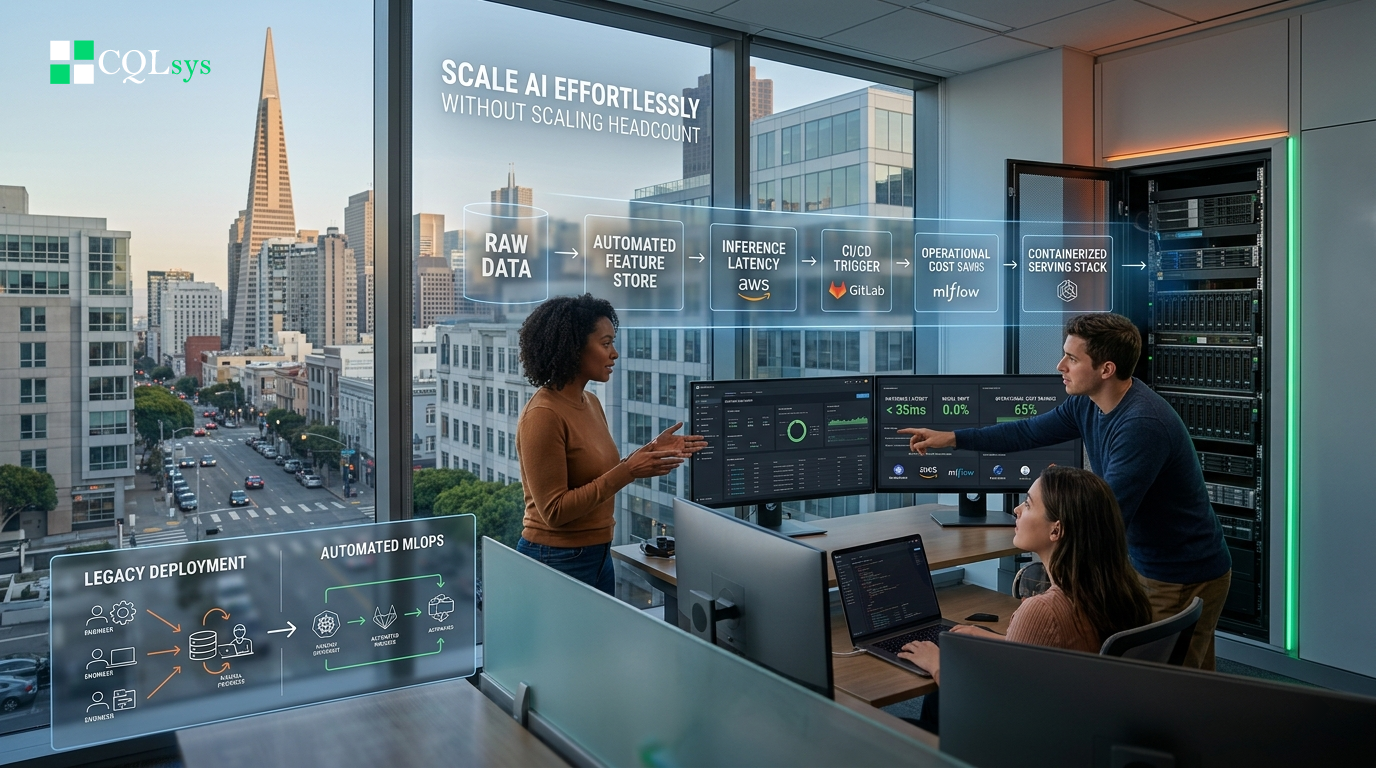
The San Francisco SaaS Dilemma: High AI Demands, Soaring Headcount Costs
San Francisco remains the undisputed epicenter of B2B software innovation, but founding teams and engineering directors face an operational bottleneck. Integrating intelligence into product suites is no longer optional; buyers demand hyper-personalized workflows, predictive analytics, and conversational interfaces. However, attempting to scale MLOps for SaaS companies in San Francisco using legacy development approaches leads directly into a talent trap. Hiring specialized site reliability engineers, machine learning platform engineers, and data infrastructure teams in the Bay Area drives payroll expenses skyward, burning through venture rounds without delivering linear revenue growth.
The root cause lies in treating intelligent features like traditional application code. While standard web services maintain predictable behavior after deployment, production models degrade silently. When customer usage patterns shift, underlying statistical assumptions break, degrading performance across tenant accounts. Without a unified machine learning operations platform, organizations resort to manual intervention. Engineers spend upwards of 40% of their bandwidth patching scripts, converting raw features, and executing manual model pushes.
| Pipeline Model | Architecture Flow | Operational Impact |
|---|---|---|
| Traditional SaaS Pipeline | Raw Data → Manual Cleaning → Offline Jupyter Model → Manual Push to S3 | High latency, silent drift, and bloated engineering overhead |
| Automated MLOps Architecture | Raw Data → Feature Store → CI/CD Trigger → Containerized Serving Stack | Real-time feature access, drift alerting, and automatic failover |
Solving this problem requires software leaders to evaluate how to scale MLOps without hiring extra engineers. Building a modern, automated delivery strategy bridges the gap between research models and resilient software systems. By automating model tracking, validation, and serving infrastructure, companies operationalize generative AI in production applications while keeping engineering teams lean, responsive, and focused on core product value.
Companies looking to transition from raw scripts to scalable architectures can explore foundational engineering principles across the CQLsys Technologies software development practice, establishing clear operational frameworks from day one.
Architectural Blueprint for San Francisco SaaS MLOps
A resilient machine learning pipeline transforms experimental models into reliable microservices. Building this infrastructure demands a modular architecture where feature engineering, training orchestration, and serving operate independently through standardized interfaces.
| Architecture Stage | Core Input / Tooling | Operational Output | Target Platform |
|---|---|---|---|
| Data Ingestion | Kafka, Snowflake, S3 | Normalized Raw Data Vectors | Centralized Data Lake |
| Feature Management | Feast, AWS SageMaker Feature Store | Point-in-time Correct Features | Offline / Online Feature Store |
| Orchestration & CI/CD | Kubeflow, MLflow, Airflow | Validated & Registered Models | Enterprise Model Registry |
| Production Serving | EKS, Triton, SageMaker, Azure ML | Sub-millisecond API Endpoint Predictions | Containerized Kubernetes Nodes |
1. Unified Feature Stores & Data Lineage
Data inconsistency between offline training environments and online prediction services is a common source of production bugs. Implementing automated feature store management using platforms like Feast or AWS SageMaker Feature Store guarantees point-in-time correctness for dynamic attributes. Modern data lineage tracking logs data transformations, matching input vectors directly to specific model versions for strict auditing and compliance across multi-tenant environments.
2. Continuous Integration & Orchestration
Manual retraining runs create operational drag and unpredictable delivery cycles. Enterprise platforms require automated CI/CD for machine learning built on Kubeflow or MLflow. When new training data flows into storage, automated pipelines trigger schema validation, train model candidates in isolated Python environments, evaluate metrics against established baselines, and register compliant artifacts in an enterprise model registry.
3. High-Throughput Containerized Serving
Serving models to thousands of concurrent B2B users requires low real-time inference latency. Packaging models inside containerized model serving engines managed by Kubernetes or Azure ML allows cloud engines to scale dynamically based on real-time API call volumes.
| Component Layer | Technology Options | SaaS Operational Focus | Key Performance Metric |
|---|---|---|---|
| Feature Management | Feast, AWS SageMaker Feature Store | Standardizing features across training & inference | Feature retrieval latency < 10ms |
| Pipeline Orchestration | Kubeflow, MLflow, Airflow | Automating retrain triggers & validation checks | Zero-touch build execution time |
| Model Registry | MLflow Registry, Neptune.ai | Version control & compliance tracking | Complete audit trail immutability |
| Inference Engine | Triton Inference Server, AWS SageMaker, Ray Serve | Sub-millisecond predictions across tenants | 99.99% uptime at peak load |
| Monitoring Stack | Prometheus, Grafana, Evidently AI | Statistical drift & latency alerting | Time-to-detect drift < 5 minutes |
Engineering leaders planning to overhaul their backend platforms can review the full range of enterprise solutions on the CQLsys Technologies services portal to design resilient, microservice-based delivery networks.
Continuous Monitoring, Drift Detection, and Self-Healing Systems
Deploying a model to production marks the beginning of its operational lifecycle, not the end. Over time, shifts in underlying customer behavior alter signal distributions, degrading accuracy. Implementing proactive operational practices prevents silent degradation before it impacts client workflows.
| System Lifecycle Step | Monitoring & Execution Tool | Operational Action |
|---|---|---|
| 1. Prediction Logging | Inbound Payload Collector | Capture real-time feature vector inputs |
| 2. Operational Tracking | Prometheus & Grafana | Monitor endpoint latency and server health |
| 3. Statistical Evaluation | Kolmogorov-Smirnov Test Engine | Compare production vectors against baseline distributions |
| 4. Drift Alerting | Alertmanager / PagerDuty | Trigger retrain pipeline when statistical threshold breaches |
| 5. Automated Retraining | Kubeflow Pipelines | Execute retraining run and register candidate artifact |
| 6. Zero-Downtime Push | Canary Deployment Strategy | Promote validated model to live serving nodes |
Detecting Data & Concept Drift
Statistical shifts manifest in two primary ways: data drift (changes in input distributions) and concept drift (changes in mathematical relationships between inputs and targets). Enterprise setups use real-time model monitoring and drift alerting tools backed by Prometheus and Grafana. When input features breach predefined threshold limits using Kolmogorov-Smirnov tests, systems trigger alerts for engineering review.
Self-Healing Continuous Retraining
Rather than assigning developers to inspect data shifts manually, modern platforms implement automated model retraining. When statistical drift alerts fire, the system automatically provisions isolated training environments, pulls newly validated datasets, executes training scripts, and evaluates performance against active production thresholds.
If the freshly trained artifact outperforms current benchmarks, the system executes production model deployment using canary or blue-green strategy patterns. This continuous, self-healing loop forms a robust machine learning governance framework, guaranteeing model accuracy without increasing daily operational overhead.
Organizations seeking to build automated pipelines can consult our specialized teams through CQLsys Technologies AI development services to deploy production-grade intelligent systems.
Financial & Operational Scaling Matrix: Optimizing Cloud & GPU Costs
As SaaS platforms handle higher request volumes, compute costs can scale exponentially if left unchecked. High-performance accelerators like NVIDIA A100 and H100 GPUs represent significant infrastructure line items for Bay Area software companies. Scaling operations sustainably requires aggressive resource utilization strategies.
| Infrastructure Optimization Technique | Technical Execution Method | Primary Financial Benefit |
|---|---|---|
| GPU Partitioning (MIG) | Slice hardware via NVIDIA Triton & Kubernetes | Multi-tenant utilization on a single physical GPU |
| Dynamic Batching | Aggregate concurrent inference API calls | Maximize hardware pipeline execution throughput |
| Weight Quantization (INT8) | Convert FP32 floats to low-precision integers | Shrink model memory footprint by up to 75% |
| Spot Instance Retraining | Provision ephemeral EKS / Ray Clusters | Lower offline batch training compute expenses |
1. GPU Infrastructure Optimization
Running dedicated GPU instances for isolated services leads to low average compute utilization. Applying Multi-Instance GPU (MIG) slice technologies allows teams to partition physical GPUs into distinct instances. This approach maximizes compute density, serving multiple microservices from a unified hardware cluster.
2. AI Payload Optimization & Quantization
Large weights and high-precision floats increase latency and compute overhead. Applying INT8 or FP16 quantization reduces memory footprints by up to 75% without compromising prediction accuracy. Combining quantization with dynamic payload batching allows inference services to group incoming HTTP requests, maximizing pipeline execution speed.
3. Spot Instances for Off-Peak Retraining
Model retraining schedules do not require zero-latency execution guarantees. Moving continuous training pipelines to spot instance pools allows teams to run resource-intensive workloads at up to an 80% discount compared to on-demand instances, securing effective cloud infrastructure cost management.
| Strategy Vector | Native Implementation | Cost Reduction Potential | Operational Complexity |
|---|---|---|---|
| GPU Partitioning (MIG) | NVIDIA Triton / Kubernetes | 40% – 60% GPU cost reduction | Medium |
| Weight Quantization | TensorRT / ONNX Runtime | 50% memory footprint drop | Low |
| Spot Instance Retraining | AWS EKS / Ray Clusters | 70% – 80% training compute drop | Medium |
| Dynamic Batching | Triton / vLLM Serving | 3x throughput capacity gain | Low |
To review practical implementations of these cost-reduction frameworks, explore technical engineering articles on the official CQLsys Technologies blog, where our teams unpack modern infrastructure strategies.
Enterprise Use Cases in the Bay Area
B2B Fintech: Real-Time Fraud & Anomaly Scoring
A San Francisco B2B fintech platform processing millions of daily transactions required real-time risk evaluation. Their original architecture relied on manual python execution pipelines, introducing latencies over 800 milliseconds and missing rapidly evolving fraud patterns.
By adopting an enterprise MLOps implementation roadmap for SaaS, the team deployed an automated feature store alongside shadow deployment strategies. The new system evaluates live transactions against candidate models in parallel without blocking main payment flows. This setup reduced inference latency to under 35 milliseconds while allowing continuous updates without downtime.
| Traffic Routing Vector | Targeted Model Endpoint | System Behavior | Latency / SLA Target |
|---|---|---|---|
| Primary Production Path | Live Production Model | Returns decisioning payload to end-user | < 35 ms Latency |
| Shadow Execution Path | Shadow Candidate Model | Logs metrics silently for drift & audit analysis | Asynchronous Evaluation |
Conversational SaaS: LLM Orchestration & Web Integration
A San Francisco enterprise collaboration platform integrated large language models to automate document summary features. High API latency and uncontrolled compute costs threatened their unit economics.
Engineering teams implemented LLM orchestration architectures combining Node.js enterprise routers, React frontend state management, and optimized local model caching. By routing standard requests through fine-tuned small language models while reserving large models for complex tasks, the company achieved a 65% reduction in API spend while cutting response latencies in half.
| Application Layer Component | Tech Stack | Operational Responsibility |
|---|---|---|
| Frontend Dashboard | React Client Interface | User interaction & streaming state management |
| Enterprise Router | Node.js Gateway API | Intent parsing & request classification |
| SLM Inference Engine | Local Fine-Tuned Model | Process standard, repetitive text summarization |
| LLM Fallback API | Cloud Model Endpoint | Handle complex, multi-step analytical prompts |
Companies looking to mirror these web and multi-platform integrations can leverage specialized capabilities across CQLsys Technologies web development and CQLsys Technologies mobile app development offerings.
Why Choose CQLsys Technologies?
Scaling complex AI applications requires a technology partner capable of translating high-level architectural designs into production-grade infrastructure. At CQLsys Technologies, we help engineering leaders build scalable, secure, and cost-effective software systems.
| Practice Pillar | Focus Area | Technical Capabilities |
|---|---|---|
| Custom Software Development | Cloud-Native Systems | Microservice architectures, cloud migrations, enterprise backends |
| AI/ML Platform Engineering | MLOps & Generative AI | Continuous training pipelines, feature stores, drift monitoring |
| Web & Mobile Engineering | Scalable Frontend/Backend | High-performance React, Node.js, and native mobile apps |
| Dedicated Engineering Teams | Staff Augmentation | Agile integration, transparent global delivery, senior architects |
End-to-End Enterprise Software Execution
We deliver full-stack enterprise engineering solutions. From modernizing core backend systems to implementing automated delivery pipelines, our teams build robust, adaptable software tailored to your operational requirements. Learn more about our company history and technical capabilities on the CQLsys Technologies platform.
Specialist AI/ML & Generative AI Systems
Our engineers design and deploy complete machine learning operations ecosystems. We build automated retraining pipelines, integrate enterprise feature stores, establish multi-tenant tracking systems, and optimize GPU compute setups, ensuring your models deliver consistent value at scale.
Dedicated Agile Teams & Transparent Global Delivery
We integrate directly into your sprint cycles as an extension of your internal team. Operating through structured agile frameworks, we provide transparent milestone tracking, clear code documentation, and rapid execution, allowing Bay Area software firms to scale engineering capabilities efficiently.
Frequently Asked Questions
How do San Francisco SaaS startups scale MLOps cost-effectively?
Startups scale efficiently by adopting managed orchestration tools like AWS SageMaker or MLflow alongside serverless container serving. Instead of building custom platform tooling from scratch, engineering teams leverage pre-built feature stores, dynamic batching, and spot instance pools for retraining. This infrastructure automation lets companies deploy and manage high-throughput models without expanding dedicated platform engineering headcount.
What is the difference between DevOps and MLOps for SaaS?
DevOps focuses on continuous integration, delivery, and lifecycle management for deterministic software code. MLOps extends these principles to non-deterministic systems where operational performance depends on both source code and dynamic data. MLOps introduces specialized components including feature store management, automated dataset versioning, continuous drift monitoring, and automated retraining pipelines to maintain accuracy over time.
How do continuous training pipelines prevent model drift?
Continuous training pipelines connect real-time monitoring tools directly to automated build systems. When performance metrics or data distribution checks cross established risk thresholds, the system automatically runs data extraction scripts, retrains candidate models on fresh datasets, validates accuracy against baseline performance, and deploys the update without manual developer intervention.
Why is feature store management crucial for enterprise AI?
Feature stores serve as a central repository for storing, processing, and serving feature vectors used in machine learning. They prevent data leakage between training and serving stages by maintaining point-in-time correctness. In multi-tenant platforms, feature stores allow disparate microservices to access consistent, low-latency data inputs, accelerating development cycles across engineering teams.
How can B2B software companies optimize GPU infrastructure costs?
Software teams optimize hardware expenditures by implementing weight quantization (converting FP32 models to INT8), enabling dynamic request batching, and utilizing Multi-Instance GPU (MIG) slicing to share compute resources across services. Additionally, running batch retraining workflows on spot instance pools reduces infrastructure expenses by up to 80% compared to standard on-demand compute rates.
What security frameworks apply to production AI serving?
Production platforms must comply with strict enterprise data privacy standards, including SOC 2 Type II, GDPR, and HIPAA. Security implementation requires isolated tenant feature storage, end-to-end encryption for inference payloads, role-based access control (RBAC) across model registries, and explicit audit logging for every decision generated by automated pipeline assets.
When should a Bay Area startup transition from manual deployments to automated CI/CD for ML?
Startups should transition to automated delivery pipelines as soon as they serve multiple customer tenants or when manual retraining tasks consume more than 10% of engineering sprint bandwidth. Delaying this transition introduces tech debt, increases operational risk, and risks silent model degradation that can negatively impact user experience.
How does containerized model serving improve application response times?
Containerized serving packages models with optimized runtime engines like Triton or ONNX inside lightweight containers managed by Kubernetes. These engines execute concurrent model evaluations, leverage hardware acceleration efficiently, and scale instance count dynamically based on traffic spikes, ensuring sub-millisecond API response times under heavy loads.
What role does data lineage play in AI compliance?
Data lineage provides an immutable record of the exact datasets, parameters, and transformations used to train specific production models. If an enterprise customer requests an audit or exercises data deletion rights, comprehensive lineage tracking allows organizations to identify affected model iterations, document compliance, and trigger targeted retraining cycles reliably.
How can enterprise teams implement shadow deployments for LLMs?
Shadow deployments route real production user requests to both the active primary model and a secondary candidate model in parallel. The candidate model processes inputs and logs metrics silently without returning its responses to end-users. Engineering teams analyze real-world performance, safety guardrails, and latency profiles under live traffic before promoting the candidate model to primary status.
Strategic Call to Action
Scaling your platform's intelligence does not require inflating payroll overhead. By building automated pipelines, establishing drift detection monitoring, and optimizing compute infrastructure, your organization can deliver high-performance features while keeping engineering teams lean and effective.
At CQLsys Technologies, we build enterprise software architectures, automated delivery pipelines, and cloud systems designed for performance and scale. Whether you need to automate existing deployment cycles, implement generative AI tools, or augment your engineering teams with dedicated technical specialists, our teams are ready to deliver.
Take the next step in streamlining your software architecture:
- Schedule a consultation with our senior solutions architects via the CQLsys Technologies contact portal.
- Connect with our technical leadership team on CQLsys Technologies LinkedIn.
- Follow our ongoing engineering updates on CQLsys Technologies Facebook and explore our team culture on CQLsys Technologies Instagram.