Natural Language Processing Course in Chandigarh: Syllabus, Tools & Careers
Students and engineering graduates across Chandigarh, Mohali, and Panchkula encounter systems powered by Natural Language Processing every single day. From automated sentiment classifiers and language translation engines to enterprise chatbots and large language models, linguistic computing shapes how humans interact with modern digital infrastructure. As technology hubs expand across the Tricity region, the demand for qualified computational professionals continues to grow. Enrolling in a comprehensive NLP course in Chandigarh allows candidates to bridge the gap between academic theory and practical software execution. For individuals exploring options such as an AI course in Chandigarh, acquiring skills in computational linguistics, sequence modeling, and transformer architectures provides a direct route into artificial intelligence engineering. This article provides a comprehensive overview of the curriculum, essential toolstacks, career trajectories, and educational choices available to students in the regional market.
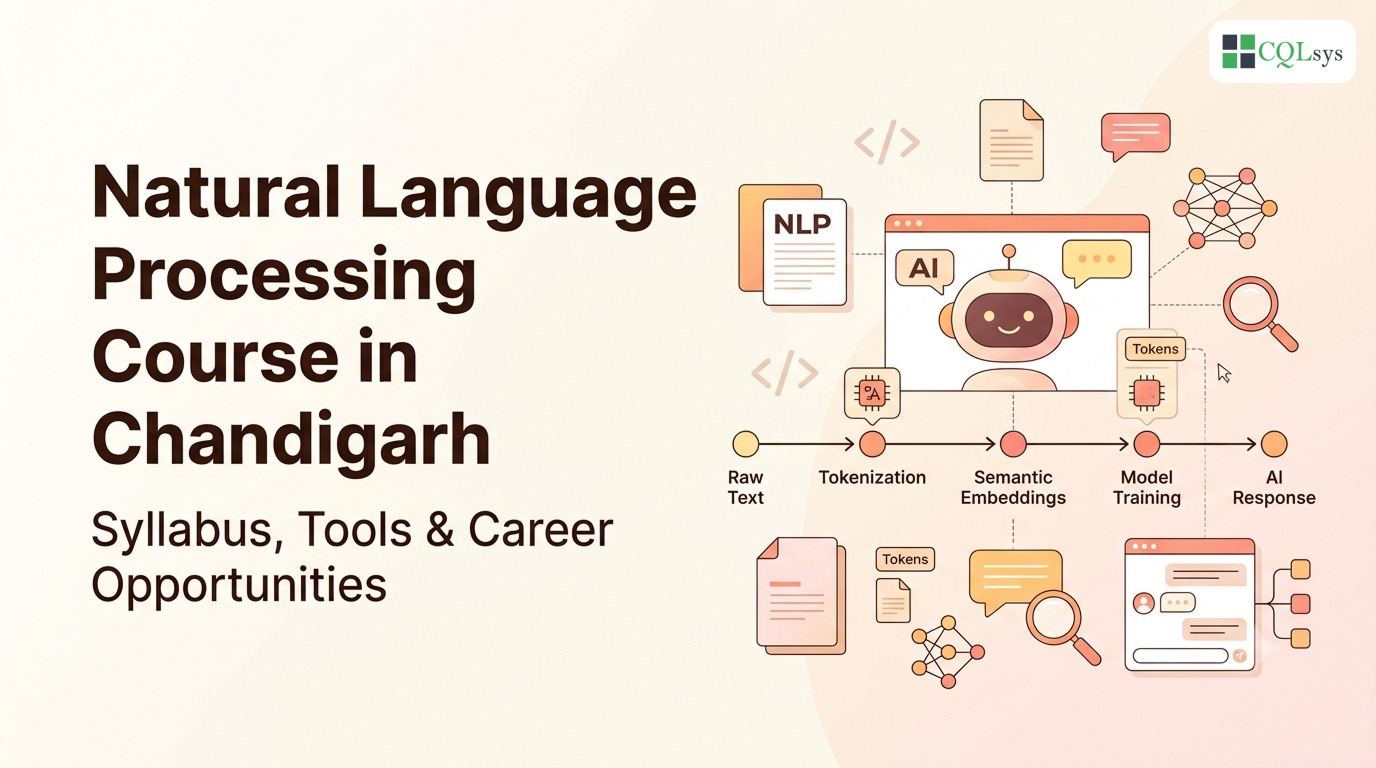
Raw Text Data Input → Linguistic Tokenization → Semantic Vectorization → Model Training → Real-Time Inference
Understanding Natural Language Processing in Modern Computing
Natural Language Processing sits at the intersection of computer science, linguistics, and mathematical modeling. It enables machines to parse, analyze, comprehend, and generate human speech and written text. Human language relies on unstructured context, subtle idiom, dynamic vocabulary, and complex syntax rules that traditional software logic cannot handle easily.
When students decide to learn artificial intelligence, they move beyond rigid conditional programming. They discover how statistical models transform raw text strings into high-dimensional numerical vectors that algorithms evaluate.
User Query Input → Text Preprocessing → Token Embeddings → Vector DB Context Retrieval → Transformer Inference → Validated Response
Core Fundamentals of Text Processing
Unstructured Corpus → Tokenization → Stop-Word Filtering → Stemming & Lemmatization → Numerical Representations
- ● Tokenization: Splitting unstructured text streams into discreet semantic units such as words, sub-words, or character sequences.
- ● Lemmatization and Stemming: Reducing derived words to their base linguistic dictionary root to normalize text fields.
- ● Named Entity Recognition: Locating and classifying entities within text bodies into predefined categories such as names, places, organizations, and numeric expressions.
- ● Vector Embeddings: Translating discrete textual tokens into dense numeric vectors that retain semantic relationships within continuous vector spaces.
Students evaluating a professional Artificial Intelligence course in Chandigarh study how these fundamental operations form the prerequisite preprocessing layers for complex neural models.
Complete Curriculum of an Industry-Aligned NLP Program
A structured curriculum ensures that learners progress smoothly from foundational programming and statistics to advanced generative architectures. Training providers across Tricity build programs to meet current industry demands.
When evaluating an AI training in Chandigarh, prospective students should review the curriculum to confirm it covers both traditional statistical frameworks and contemporary transformer models.
Detailed Syllabus Breakdown
- Foundations of Language Processing: Text normalization, regular expressions, corpus management, and frequency distribution calculations.
- Feature Extraction Strategies: Bag-of-Words models, Term Frequency-Inverse Document Frequency calculations, and n-gram analysis.
- Word Embedding Architectures: Dense vector mapping, semantic distance measurement, and context-aware word representations.
- Sequence Modeling Frameworks: Recurrent neural networks, long short-term memory architectures, and bi-directional sequence processing.
- Transformer Architectures: Self-attention mechanisms, multi-head attention blocks, encoder-decoder frameworks, and positional encoding.
- Large Language Models: Fine-tuning methodologies, prompt engineering, retrieval-augmented generation architectures, and parameter-efficient adaptation.
Technology Stack and Tools Covered in Training
Professional language processing relies on an ecosystem of open-source libraries, specialized compute frameworks, and vector database management platforms. Students enrolled in an Artificial Intelligence training in Chandigarh work directly with industry-standard software environments throughout their coursework.
Standard Software Ecosystem:
- Data Pipeline & Parsing: Python, NumPy, Pandas, NLTK, spaCy
- Classical ML & Vectorization: Scikit-Learn, Gensim
- Deep Learning Implementations: PyTorch, TensorFlow
- Transformer & Generative Stacks: Hugging Face, LangChain, LlamaIndex
- Vector Search Ingestion: Pinecone, Qdrant, ChromaDB, Milvus
Key Libraries and Software Frameworks
- ● Linguistic Analysis Libraries: Software toolkits used for tokenization, part-of-speech tagging, syntactic parsing, and coreference resolution.
- ● Machine Learning Toolkits: High-performance libraries used for feature engineering, matrix operations, and classical text classification algorithms.
- ● Deep Learning Engines: Frameworks used to design, train, evaluate, and optimize deep neural networks.
- ● Vector Repositories: High-dimensional databases engineered for fast nearest-neighbor lookups during semantic document retrieval.
Candidates preparing for an AI & Machine Learning course in Chandigarh gain direct exposure to these tools by building, deploying, and monitoring functional code bases.
Traditional Machine Learning vs. Deep Learning and Generative AI
Understanding the evolution of language processing helps students evaluate different algorithmic techniques and choose the right tool for a given engineering challenge.
Evolutionary Progression:
Rule-Based Parsing (1980s) → Statistical ML & N-Grams (2000s) → Recurrent Neural Networks (2015) → Self-Attention Transformers (2017+) → Autonomous Agentic AI (Present)
| Factor | Classical Text Processing | Deep Learning Models | Generative AI & Large Models |
|---|---|---|---|
| Primary Method | Rule engines and statistical counts | Neural networks with hidden layers | Multi-head self-attention transformers |
| Feature Extraction | Manual feature engineering | Automated feature extraction | Zero-shot contextual understanding |
| Contextual Range | Localized n-gram windows | Sequential context chains | Deep multi-thousand token contexts |
| Dataset Needs | Small labeled datasets | Moderate to large annotated corpora | Massive web-scale unannotated datasets |
| Compute Overhead | Standard CPU environments | Single GPU acceleration | Distributed multi-GPU clusters |
Learners reviewing the Best AI course in Chandigarh can select programs that cover classical algorithms alongside advanced transformer fine-tuning strategies.
Essential Prerequisites Before Enrolling
Students asking about prerequisites for AI and ML can accelerate their learning by building foundational skills across a few core areas before starting advanced coursework.
Learner Readiness Journey:
Mathematical Foundations → Core Programming Logic → Data Wrangling Capability → AI & ML Specialization
- ● Core Programming Foundations: Comfort with fundamental control flow, object-oriented principles, modular functions, and file processing.
- ● Linear Algebra and Matrix Calculus: Familiarity with vector spaces, matrix multiplication, dot products, derivatives, and gradient calculations.
- ● Probability and Descriptive Statistics: Understanding conditional probability, Bayes' Theorem, standard distributions, variance, and hypothesis testing.
- ● Database Management Systems: Basic SQL literacy for extracting, filtering, and joining structured datasets from storage engines.
Whether a candidate considers an AI with Python course in Chandigarh or explores free courses on artificial intelligence online, mastering these prerequisites helps prevent early learning bottlenecks.
Practical Student Projects and Portfolio Building
Employers evaluate technical candidates based on demonstrable capability, code quality, and problem-solving skills rather than certificates alone. Constructing a portfolio of complete end-to-end applications is an essential part of career preparation.
Students preparing through a Machine Learning course in Chandigarh should build real-world applications that showcase their technical capabilities.
Sample Project Pipeline:
Data Acquisition → Preprocessing & Sanitization → Model Selection & Training → API Containerization → Cloud Deployment
High-Impact Project Examples
- Automated Enterprise Support Router: A system that ingests customer emails, classifies intent, extracts key order parameters, and routes tickets to appropriate support teams.
- Contextual Knowledge Retrieval System: An application using vector embeddings and semantic search to answer user questions from internal PDF documents.
- Multilingual Aspect Sentiment Evaluator: A sentiment analyzer that processes e-commerce customer feedback across regional languages and pinpoints sentiment for specific product attributes.
- Real-Time Anomaly Detection Engine: A classifier that monitors unstructured transaction logs to identify malicious access attempts or operational errors in real time.
Participating in an AI & ML industrial training in Chandigarh gives students access to laboratory environments, compute resources, and mentor oversight while building these project portfolios.
Comprehensive Student Learning Roadmap
A structured learning plan helps students build strong fundamentals while steadily advancing toward complex technologies. The roadmap below outlines a standard learning trajectory used across top academic and professional training programs.
Phase 1: Fundamental Preparation (Weeks 1–4)
Focus: Python syntax, mathematical prerequisites, data manipulation, and exploratory analysis.
Phase 2: Statistical Machine Learning (Weeks 5–8)
Focus: Supervised and unsupervised algorithms, text vectorization, evaluation metrics, and model tuning.
Phase 3: Deep Neural Architectures (Weeks 9–12)
Focus: Multi-layer perceptrons, sequence architectures, attention layers, and model deployment APIs.
Phase 4: Advanced Generative Engineering (Weeks 13–16)
Focus: Transformer architectures, vector search systems, retrieval-augmented generation pipelines, and model evaluation.
Phase 5: Production Deployment and Portfolio Launch (Weeks 17–20)
Focus: Application containerization, microservice deployment, cloud integration, security validation, and portfolio optimization.
Enrolling in an AI training institute in Chandigarh helps learners stay on track through each phase of this structured roadmap.
Factors Influencing AI Course Duration and Fees
Understanding the variables that influence program duration and fees helps students choose an educational option that aligns with their budget and schedule.
When researching the AI course fees in Chandigarh and the AI course duration in Chandigarh, candidates should evaluate program features based on several key factors.
Value Evaluation Framework:
Instruction Model + Infrastructure Access + Curriculum Scope + Portfolio Projects = Return on Education
Key Cost and Duration Factors
- ● Compute and Hardware Allocation: Access to cloud GPU resources for training deep neural networks and large models.
- ● Instruction Model: Programs led by experienced industry practitioners often require higher tuition investments than passive, self-paced courses.
- ● Practical Project Supervision: Dedicated guidance during laboratory sessions, code reviews, and capstone project development.
- ● Schedule and Intensity: Accelerated bootcamps run on full-time multi-week schedules, whereas flexible formats span several months.
Students looking for an AI institute in Chandigarh should compare curricula, faculty experience, laboratory infrastructure, and project depth across multiple centers before deciding.
Regional Opportunities across Chandigarh, Mohali, and Punjab
The Tricity region—comprising Chandigarh, Mohali, and Panchkula—has developed into a vibrant technology hub with expanding opportunities in software engineering, digital product development, and IT services.
Selecting an AI course in Chandigarh Mohali or an Artificial Intelligence course in Chandigarh Mohali positions students near local software companies, IT parks, and startup incubators.
Regional Educational Pathways:
School Mathematics & Foundations → Undergraduate Technical Education → Practical Regional Training → Regional Technology Hub Roles
Target Student Audience Profiles
- ● Undergraduate Students: Pursuing degrees in computer science, information technology, electronics, or mathematics, and looking to add industry-relevant specialization skills.
- ● Students Entering After Class 12: Seeking an AI course after 12th in Chandigarh to build strong foundational skills in programming and data analysis alongside their university studies.
- ● Working Software Engineers: Professional developers exploring an artificial intelligence course for working professionals to transition into machine learning or AI engineering roles.
- ● Non-Technical Graduates: Analytical professionals building foundational skills to pursue roles in prompt engineering, technical project management, or AI data operations.
Choosing a regional AI & ML training in Chandigarh gives students access to local mentorship, in-person peer collaboration, and network connections across regional IT parks.
Career Opportunities and Professional Pathways
The skills developed in an advanced language processing program translate into opportunities across software companies, data analytics firms, e-commerce businesses, and enterprise technology groups.
Candidates who complete a practical AI course with placement in Chandigarh can pursue a variety of specialized industry roles.
Career Growth Trajectory:
Junior AI Data Analyst → Machine Learning Engineer → Senior NLP Specialist → Principal AI Solutions Architect
Primary Technical Roles
- ● NLP Engineer: Designs, implements, and maintains production language models, tokenizers, and text extraction pipelines.
- ● Machine Learning Engineer: Builds, deploys, and monitors general predictive models, inference APIs, and data transformation routines.
- ● Generative AI Developer: Builds custom enterprise applications using retrieval-augmented generation pipelines, fine-tuned language models, and agentic workflows.
- ● AI Solutions Architect: Designs complex enterprise system architectures that combine cloud infrastructure, data pipelines, vector repositories, and model inference microservices.
Prospective students evaluating the Best Artificial Intelligence course in Chandigarh should select programs that align with their target career goals.
Specializations: Generative AI, Deep Learning, and Agentic AI
As artificial intelligence technologies mature, training programs are introducing specialized modules that cover advanced model architectures.
Technology Specialization Strata:
- Base Layer: Classical Machine Learning & Predictive Analytics
- Second Layer: Deep Learning Neural Networks & Computer Vision
- Third Layer: Generative AI & Retrieval-Augmented Generation
- Frontier Layer: Autonomous Agentic AI & Dynamic Planning
Key Advanced Modules
- ● Deep Learning Specialization: Enrolling in a Deep Learning course in Chandigarh covers deep neural network design, hyperparameter tuning, and gradient optimization strategies.
- ● Generative AI Specialization: Enrolling in a Generative AI course in Chandigarh or pursuing Generative AI training in Chandigarh focuses on prompt engineering, transformer fine-tuning, and retrieval-augmented architectures.
- ● Agentic AI Systems: Taking an Agentic AI course in Chandigarh or attending Agentic AI training in Chandigarh covers autonomous software agents capable of executing multi-step tasks, utilizing external tools, and dynamically processing complex workflows.
Evaluating options like the Best AI & ML course in Chandigarh helps candidates select programs that cover these emerging technical areas.
Evaluating Training Institutes in the Tricity Region
Choosing the right institute requires evaluating several operational criteria to ensure high-quality instruction and practical skill development.
Institute Selection Checklist:
- [ ] Industry-Aligned Curriculum (ML, DL, GenAI, MLOps)
- [ ] Compute Resources (GPU Access, Cloud Credits)
- [ ] Practical Laboratory Work & Code Reviews
- [ ] Portfolio Project Supervision
- [ ] Faculty with Industry Engineering Experience
Candidates looking for the Best AI training institute in Chandigarh or researching an Artificial Intelligence institute in Chandigarh should review these criteria carefully.
Selecting a provider that awards a recognized AI certification course in Chandigarh ensures that candidates build a strong foundation of verified practical skills.
Frequently Asked Questions
1. What academic background is required to enroll in an NLP course in Chandigarh?
Most programs welcome candidates with a background in computer science, engineering, mathematics, physics, or data analytics. While non-technical students can learn foundational concepts, technical roles require comfort with basic programming logic, linear algebra, and probability statistics.
2. Can I take a machine learning course online while living in Chandigarh?
Yes, students can combine online learning resources with local classroom training. Many learners build initial concepts using online materials before joining structured regional bootcamps for hands-on project work, laboratory access, and career guidance.
3. How long does a typical AI & Machine Learning course in Chandigarh take?
Program durations generally range from 3 to 6 months. Short-term introductory modules run on accelerated multi-week schedules, whereas comprehensive industrial training programs extend over several months to include deep learning, generative AI, and portfolio capstone development.
4. Are there suitable AI courses after 12th in Chandigarh?
Yes, students entering after Class 12 can pursue foundational courses that cover programming basics, Python data structures, linear algebra, and entry-level machine learning algorithms. These programs build a strong foundation alongside formal university degree studies.
5. What software libraries are taught during natural language processing training?
Industry-aligned training programs cover standard open-source libraries including NLTK, spaCy, Scikit-Learn, PyTorch, TensorFlow, Hugging Face Transformers, LangChain, and vector databases like ChromaDB and Pinecone.
6. What is the difference between general AI courses and specialized NLP programs?
General artificial intelligence programs cover a broad range of topics, including classical statistical modeling, computer vision, robotics, and decision trees. Specialized language processing programs focus specifically on text data processing, token embeddings, sequence models, transformers, and large language architectures.
7. Is programming experience required before starting an AI with Python course in Chandigarh?
Prior programming experience is helpful, but many introductory courses cover fundamental Python concepts—such as variables, loops, functions, data structures, and file operations—during the initial phase of training.
8. What career opportunities exist after completing AI & ML training in Chandigarh?
Graduates can pursue regional and national job opportunities across roles such as NLP Engineer, Machine Learning Engineer, AI Application Developer, Data Scientist, and Generative AI Integrator.
9. How do practical portfolio projects impact job placement opportunities?
Building a portfolio of complete, containerized applications gives employers tangible evidence of a candidate's technical skills, code quality, software design capability, and problem-solving approach.
10. Why is Chandigarh Mohali a strong region for artificial intelligence training?
The Tricity region hosts major educational institutions, software development companies, IT parks, and technology startups. This concentration creates an ideal environment for hands-on technical learning, peer networking, and early career entry.
Strategic Learning Next Steps
Building a career in computational linguistics and artificial intelligence requires structured study, hands-on programming practice, and continuous project development. Choosing an industry-aligned training path ensures that learners build practical skills that match current technology needs.
To explore structured curriculum pathways and hands-on laboratory options, consider enrolling in a dedicated AI course in Chandigarh. To learn more about enterprise digital capabilities, software development frameworks, and AI engineering services, visit the CQLsys Technologies homepage, explore our About Us background, read insights on the CQLsys Blog, review our Artificial Intelligence development services, examine our full software services portfolio, or reach out directly through our official Contact Page to discuss your educational and project goals.