Offshore AI Integration for Healthcare Companies in Toronto: Reduce Development Costs by 40% Without Compromising Compliance
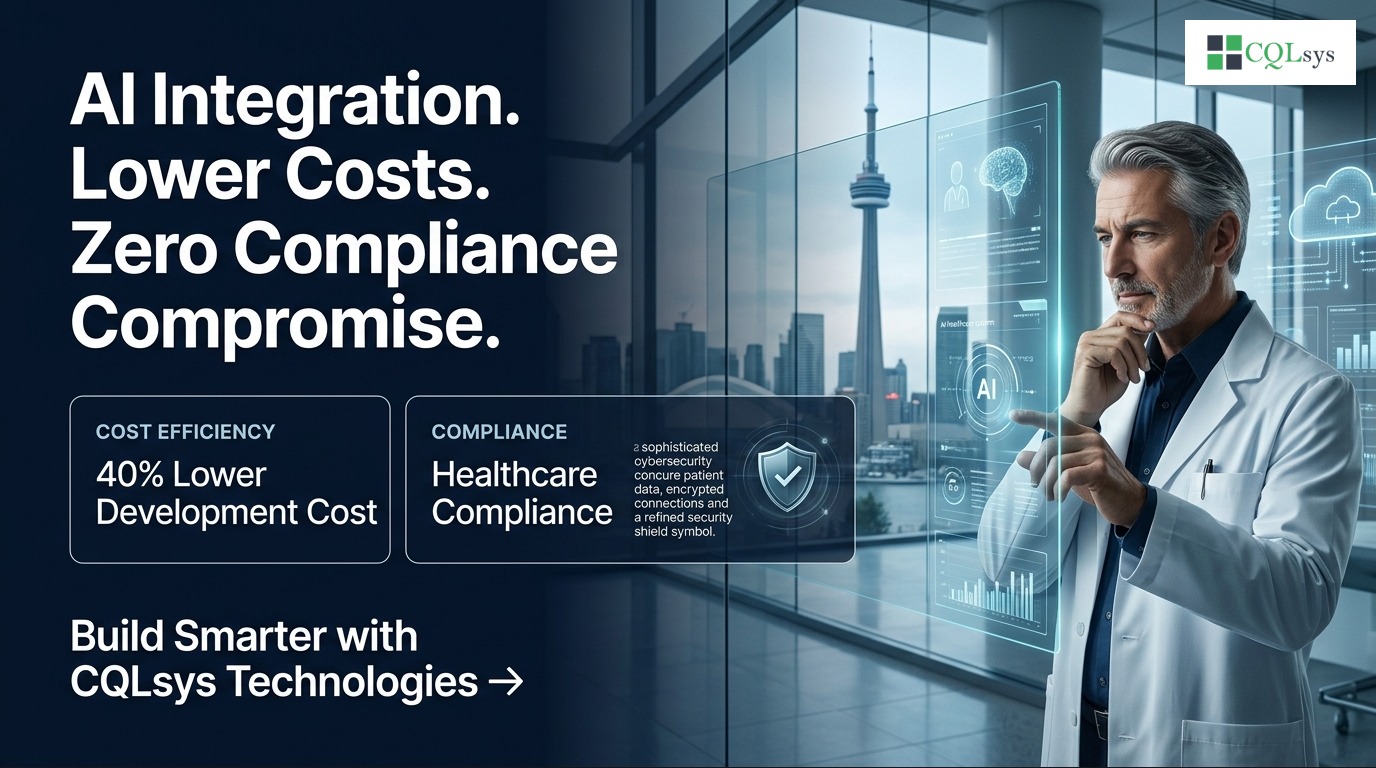
Toronto has firmly established itself as a premier global hub for healthcare innovation and artificial intelligence research. From the Discovery District along University Avenue to the growing healthtech startups across the Greater Toronto Area (GTA), local enterprises are aggressively embedding intelligence into clinical workflows, diagnostic engines, and administrative platforms.
However, scaling these complex applications locally presents immediate financial and operational hurdles. High local engineering salaries, intense competition for specialized machine learning talent, and lengthy recruitment cycles make rapid deployment cost-prohibitive.
To remain competitive, forward-thinking executives are turning to offshore AI integration for healthcare companies in Toronto. Partnering with an experienced offshore engineering partner allows healthtech firms, hospital networks, and medical SaaS providers to capture up to 40% in cost savings while accelerating time-to-market.
The primary concern for Canadian health technology leaders remains data sovereignty and regulatory compliance. Integrating artificial intelligence through cross-border engineering teams must never expose Personal Health Information (PHI).
Achieving significant cost reduction without compromising compliance requires a structured integration methodology. By enforcing strict local data governance, leveraging zero-trust architecture, and aligning with Ontario's Personal Health Information Protection Act (PHIPA) alongside federal PIPEDA mandates, healthtech companies can capture global engineering efficiencies securely.
The Toronto Healthtech Landscape: Innovation Meets Financial Strain
The GTA healthcare ecosystem operates at a unique intersection of world-class academic research and stringent public health regulation. Organizations across Ontario are digitizing patient touchpoints, deploying predictive triage models, and automating complex billing workflows.
Despite this momentum, scaling in-house artificial intelligence capabilities inside Ontario comes with distinct economic pressures:
- Elevated Local Engineering Costs: The median compensation for senior artificial intelligence architects and machine learning engineers in Toronto has grown significantly. When combined with payroll overhead, benefit structures, and local infrastructure expenses, the operational cost of scaling an in-house AI team becomes restrictive for growing mid-market firms.
- Talent Scarcity: While academic institutions produce high-tier research talent, senior software engineers who possess dual expertise in deep learning models and healthcare protocols (such as HL7, FHIR, and DICOM) are scarce.
- Protracted Time-to-Market: The average recruitment cycle for specialized AI roles in North America ranges from three to five months. In healthcare, where first-mover advantage dictates market leadership, these delays stall innovation pipelines.
- Regulatory Friction: Local healthcare organizations operate under strict oversight from the Information and Privacy Commissioner of Ontario (IPC). AI initiatives must guarantee end-to-end data privacy, explainability, and auditable governance from day one.
Engaging dedicated offshore engineering teams directly addresses these operational bottlenecks. By combining local technology leadership with global execution talent, Toronto enterprises can streamline development cycles while preserving working capital for clinical validation and market expansion.
Navigating Cross-Border Compliance: PHIPA, PIPEDA, and Data Governance
Offshore software development in healthcare requires clear data protection controls. The common belief that cross-border engineering automatically violates Canadian privacy laws is incorrect. Canadian regulations—specifically Ontario's PHIPA and Canada's PIPEDA—do not forbid offshore engineering; rather, they demand strict control, explicit governance, and unyielding protection of Personal Health Information (PHI).
Executing compliant offshore AI integration requires implementing several core structural guardrails:
1. Zero PHI Exposure Policy for Offshore Teams
Offshore software engineers do not require access to actual patient records to build, train, or integrate artificial intelligence models. Advanced engineering workflows use structured synthetic data generation and automated de-identification pipelines within Canadian cloud regions (such as AWS Canada Central or Azure Canada Central). Offshore teams write code, optimize model logic, and build API layers using fully anonymized datasets that match production schemas without containing real patient attributes.
2. Local Endpoint Encryption & Perimeter Control
All production data pipelines, vector databases, and primary application layers remain hosted within Canadian geographic boundaries. Offshore developers connect to isolated development environments through secure Zero-Trust Network Access (ZTNA) with strict Multi-Factor Authentication (MFA). Direct downloading, local caching, or remote saving of source environments is blocked at the infrastructure policy level.
3. Business Associate & Data Processing Agreements
Legal frameworks must mirror technical controls. Cross-border integrations mandate Comprehensive Data Processing Agreements (DPAs) and strict contractual alignment with PHIPA guidelines for Health Information Network Providers (HINPs). Contractual clauses explicitly govern data ownership, audit rights, breach notification timelines, and strict restrictions on third-party data processing.
High-Level Solution Architecture for Secure Offshore AI Integration
To successfully execute an offshore AI integration project, enterprise architectures must physically decouple model training and application engineering from actual clinical data storage.
Application Workflow Architecture:
Patients and Clinicians ? Web & Mobile Frontends (React / Next.js) ? Cloudflare WAF / Identity Management (OAuth2 / RBAC) ? API Gateway & Microservices ? Canadian Cloud Boundary (Encrypted Production DB / Vector DB / AI Inference Engine)
Developer Integration Path:
Offshore Developers ? Zero-Trust Gateway (ZTNA / MFA) ? Isolated Developer Sandbox (Synthetic Data / Model Fine-Tuning) ? CI/CD Pipeline ? Canadian Sovereign Cloud Boundary
Architectural Component Breakdown
User & Experience Layer
Serves as the interaction point for patients, clinicians, and health administrators. Designed using modern frontend frameworks, this layer communicates securely with API endpoints over HTTPS using TLS 1.3 encryption. It captures user inputs and renders AI-driven clinical insights without storing persistent local state on client devices.
Security & Identity Layer
Forms the defensive perimeter surrounding all healthcare services. Incorporates Web Application Firewalls (WAF), Distributed Denial of Service (DDoS) mitigation, and enterprise Identity Providers (IdP). Enforces fine-grained Role-Based Access Control (RBAC) to ensure clinicians only view data relevant to their active care sessions.
Application & API Layer
Acts as the orchestration engine. Manages business logic, clinical workflow routing, and data transformations. Built-in HL7/FHIR translation services standardize incoming Electronic Health Record (EHR) feeds before routing them to downstream predictive services.
Canadian Data & AI Processing Boundary
Houses all sensitive infrastructure inside Canadian data centers (AWS Canada Central / Azure Canada Central). Real-time patient records, vector embeddings, and machine learning models run exclusively within isolated subnets. Data is encrypted both in transit (TLS 1.3) and at rest (AES-256 with key management managed via AWS KMS or HashiCorp Vault).
Offshore Development Boundary
The isolated environment where offshore software engineering teams operate. Teams build application microservices, design automated test suites, refine AI algorithms, and execute model hyperparameter tuning using synthetic datasets. Code changes pass through strict static security analysis (SAST) and automated CI/CD pipelines before deployment into Canadian production environments.
Core Healthcare Use Cases Delivered via Offshore Engineering
Outsourcing specialized technical execution to an enterprise offshore team allows Toronto healthcare organizations to accelerate the deployment of high-impact AI capabilities:
- Clinical AI Summarization: Automated processing of clinician notes, ambient voice audio, and Electronic Health Record (EHR) parsing using custom NLP pipelines.
- Operational Automation: Automated medical prior authorizations, insurance claims verification, and automated billing engines.
- Patient Care Predictive Analytics: Real-time patient triage scoring, predictive readmission alerts, and clinical decision support.
1. Automated Clinical Documentation & EHR Summarization
Physicians spend up to three hours daily on administrative documentation inside EHR systems. Offshore AI engineers construct custom Natural Language Processing (NLP) and Large Language Model (LLM) pipelines that ingest ambient physician-patient consultations, automatically extract relevant clinical entities, and structure clinical notes directly into Epic or Cerner via FHIR interfaces.
2. Prior Authorization & Medical Claims Automation
Medical billing and prior authorization requests in Canadian private healthcare clinics often involve manual document verification. Offshore teams design Computer Vision (OCR) and document intelligence engines that parse unstructured medical receipts, verify coverage constraints against policy rules, and accelerate claims approval workflows.
3. Predictive Patient Triage & Readmission Risk
Using historical clinical parameters, offshore machine learning teams build predictive risk scoring models. These models analyze real-time vital signs and lab results to alert nursing staff to impending patient deterioration or elevated 30-day readmission risks, enabling proactive clinical intervention.
Technology Stack Recommendations for Healthcare AI Systems
Selecting a modular, secure, and vendor-neutral technology stack ensures that healthtech solutions remain performant, scalable, and easy to maintain.
| Architecture Layer | Component | Recommended Technology | Business Rationale |
|---|---|---|---|
| Frontend | Patient/Clinical Web | React / Next.js | High performance, accessible UI components, strong community ecosystem. |
| Mobile | Cross-Platform App | React Native / Flutter | Single codebase for iOS and Android, reducing long-term maintenance costs. |
| Backend Services | Microservices Architecture | Node.js / Python (FastAPI) / .NET | Native support for async processing, ML library integration, and robust enterprise tooling. |
| Healthcare Integration | Interoperability Engine | HAPI FHIR / Mirth Connect | Native compliance with HL7 v2, HL7 v3, and FHIR standards across Canadian clinics. |
| AI & Machine Learning | Model Development / LLM | PyTorch / TensorFlow / LangChain | Industry standards for custom model tuning, RAG pipeline construction, and orchestration. |
| Vector Search | Contextual Search Engine | Pinecone / Qdrant / Milvus | Enables semantic search over encrypted clinical documentation and medical research. |
| Database | Relational & Document | PostgreSQL / MongoDB | Robust transactional consistency, JSON storage capability, and native spatial/text search. |
| Cloud & Security | Sovereign Infrastructure | AWS Canada Central / Azure Canada | Ensures physical data residence inside Canada while providing auto-scaling infrastructure. |
Strategic Cost Analysis: Local vs. Offshore Hybrid Model
Establishing a hybrid model—combining local Canadian product management and compliance leadership with offshore software engineering—directly transforms software capital expenditure.
| Expense Category | 100% In-House Toronto Team | Offshore Hybrid Integration Model | Net Financial Impact |
|---|---|---|---|
| Senior AI Architect | $190,000 – $240,000 CAD/yr | $70,000 – $95,000 CAD/yr | 60% Cost Reduction |
| Senior Full-Stack Engineer | $130,000 – $165,000 CAD/yr | $45,000 – $60,000 CAD/yr | 62% Cost Reduction |
| DevOps / Security Engineer | $140,000 – $175,000 CAD/yr | $50,000 – $65,000 CAD/yr | 61% Cost Reduction |
| Recruitment & Hiring Fees | 15% – 20% of first-year salary | $0 (Managed Team Model) | 100% Elimination |
| Benefits, Taxes & Office | ~22% salary markup | Included in partner rate | Significant Savings |
| Time-to-Deploy Full Team | 12 to 18 Weeks | 2 to 4 Weeks | 75% Acceleration |
| Blended Annual Budget (6 Roles) | $1,050,000 CAD (Avg) | $480,000 CAD (Avg) | ~54% Total Savings |
By reinvesting these engineering savings, Toronto companies can dedicate greater capital toward local clinical trials, health system sales, and regulatory advisory counsel, maximizing overall enterprise value.
Implementation Roadmap for Toronto Healthcare Companies
A structured deployment process mitigates technical risk and guarantees regulatory alignment throughout the software development lifecycle.
- Phase 1: Discovery & Compliance Alignment
(Weeks 1-3)
Define PHIPA boundaries, audit architecture, establish synthetic data schemas, and conduct initial risk assessments. - Phase 2: Environment Isolation & CI/CD
Setup (Weeks 4-6)
Provision AWS/Azure Canada region, configure Zero-Trust Network Access (ZTNA), and build secure developer pipelines. - Phase 3: Model Tuning & API Integration
(Weeks 7-14)
Offshore engineering team constructs AI engine, FHIR routers, microservices, and user interfaces using synthetic datasets. - Phase 4: Validation, Penetration Testing &
Audit (Weeks 15-18)
Third-party security audit, PIPEDA compliance sign-off, clinical accuracy testing, and vulnerability management. - Phase 5: Controlled Deployment &
Optimization (Ongoing)
Phased clinical rollout, automated performance monitoring, iterative enhancement, and continuous SLA support.
Why Choose CQLsys Technologies for Offshore AI Integration?
Executing enterprise-grade healthtech development requires an engineering partner that combines deep technical capability with a clear understanding of regulatory requirements. CQLsys Technologies provides specialized offshore AI development services tailored specifically to the requirements of the Canadian healthtech ecosystem.
Key Capabilities and Differentiators
- Deep AI & Machine Learning Expertise: CQLsys designs modern intelligent software systems, including custom LLM fine-tuning, computer vision processing, and predictive analytics platforms.
- Healthcare Interoperability Mastery: Our engineering teams hold extensive experience integrating software platforms with major Electronic Health Record systems via HL7, FHIR, and DICOM standards.
- Security & Compliance First Mindset: We build applications using zero-trust architectural blueprints, enabling full compliance with PHIPA, PIPEDA, and HIPAA regulations without sacrificing development speed.
- Proven Offshore Cost Efficiency: Our structured managed-team model enables Toronto enterprises to scale their engineering capacity rapidly while reducing overall development costs by up to 40%.
- Flexible Delivery Engagement Models: From dedicated engineering pods to full-scale custom software development services, we adapt to your organization's exact governance and delivery workflows.
Through our dedicated AI Development Services and custom Software Development Capabilities, CQLsys Technologies bridges the gap between cost reduction and enterprise technical execution.
10 SEO Frequently Asked Questions (FAQs)
1. How can Toronto healthcare companies offshore AI integration while maintaining PHIPA compliance?
Toronto healthcare firms maintain PHIPA compliance by establishing strict architectural boundaries. Real patient data remains hosted strictly inside Canadian cloud environments (AWS/Azure Canada Central). Offshore engineers work within isolated sandbox environments using synthetic or fully de-identified data via secure API gateways. This approach allows developers to build, test, and tune AI logic without exposing Personal Health Information (PHI) to remote team members.
2. What is the average cost savings of offshore AI engineering for a Canadian healthtech firm?
By leveraging an offshore hybrid engineering model, Canadian healthtech enterprises typically achieve overall development cost reductions of 40% to 55%. These savings stem from lower blended hourly engineering rates, reduced local recruitment overhead, and eliminated office infrastructure expenses. Organizations can redirect these capital savings toward local clinical validation, marketing, and regulatory compliance.
3. How is patient data protected during cross-border AI software development?
Patient data is protected using end-to-end encryption (AES-256 at rest, TLS 1.3 in transit), strict Zero-Trust Network Access (ZTNA), and automated de-identification pipelines. Live production data is never stored, cached, or accessed on remote developer hardware. All developer access is monitored via centralized logging, role-based access control (RBAC), and multi-factor authentication systems.
4. Why choose offshore AI development over hiring locally in Toronto?
While Toronto offers excellent AI research talent, local recruitment for specialized senior machine learning engineers is expensive and competitive, often taking several months. Offshore AI engineering provides immediate access to seasoned technical talent at a fraction of the cost. This setup allows Toronto organizations to scale development teams rapidly, shorten release cycles, and preserve capital.
5. What healthcare data standards must offshore teams follow for Canadian deployments?
Offshore teams developing software for the Canadian healthcare ecosystem must adhere strictly to HL7 (v2/v3) and FHIR (Fast Healthcare Interoperability Resources) for clinical data exchange, DICOM for medical imaging, and SOC 2 Type II security guidelines. Adherence to these standards ensures seamless integration with major Canadian EHR platforms, diagnostic software, and laboratory systems.
6. How do offshore engineers integrate AI models with local Toronto EHR systems?
Offshore engineers build secure, containerized microservices and API interfaces that interact with local EHR platforms like Epic, Cerner, or MEDITECH through standardized FHIR interfaces. Integration tests run inside staging environments utilizing synthetic EHR data. This setup ensures that once code is deployed to Canadian production servers, data exchange occurs smoothly and securely.
7. What is the typical timeline to deploy an offshore AI healthcare integration project?
A standard enterprise AI healthcare integration timeline ranges from 12 to 20 weeks. This includes initial architecture design and compliance alignment (Weeks 1-3), isolated environment setup (Weeks 4-6), core AI fine-tuning and API integration (Weeks 7-14), and final third-party security audits and testing (Weeks 15-18) prior to controlled clinical release.
8. How does CQLsys ensure zero data leakage during offshore AI fine-tuning?
CQLsys enforces strict data protection policies through synthetic data generation, k-anonymity masking algorithms, and containerized dev environments. Machine learning models are trained and fine-tuned using anonymized datasets within isolated sandboxes. Model weights and application code are transferred to Canadian cloud subnets via automated CI/CD pipelines, keeping sensitive patient data completely isolated.
9. Can offshore teams assist with healthtech regulatory audits in Ontario?
Yes. Experienced offshore teams provide comprehensive documentation, secure source code repositories, detailed system architecture diagrams, and automated audit logging configurations. This technical documentation supports local compliance officers and legal counsel in completing Privacy Impact Assessments (PIAs) and Threat Risk Assessments (TRAs) required by Ontario health authorities.
10. How do offshore AI integrations handle real-time clinical data processing?
Real-time clinical data processing is managed via event-driven microservice architectures deployed on local Canadian cloud infrastructure. Incoming patient telemetry or clinical notes pass through local API gateways to inference engines optimized for rapid response times. The offshore team writes and optimizes the code base, while runtime execution stays entirely within Canadian cloud servers to maintain low latency and data compliance.
Accelerate Your AI Strategy with CQLsys Technologies
Scaling enterprise healthcare technology shouldn't force a compromise between development speed, operational budget, and regulatory compliance. By combining local Canadian oversight with specialized global engineering capacity, your organization can deploy intelligent, PHIPA-compliant healthcare software while reducing development costs by 40%.
Whether you need to build predictive clinical analytics engines, automate complex healthcare workflows, or integrate custom machine learning models into existing EHR platforms, CQLsys Technologies provides the expertise and engineering scale your business demands.
Ready to Optimize Your Healthtech Engineering Costs?
Schedule a confidential consultation with our AI Solution Architects today to discuss your technical requirements, architectural design, and compliance frameworks.
- Schedule an Executive AI Consultation: Contact CQLsys Technologies
- Explore Our Engineering Capabilities: CQLsys Software Services
- Connect on LinkedIn: CQLsys Technologies Company Page