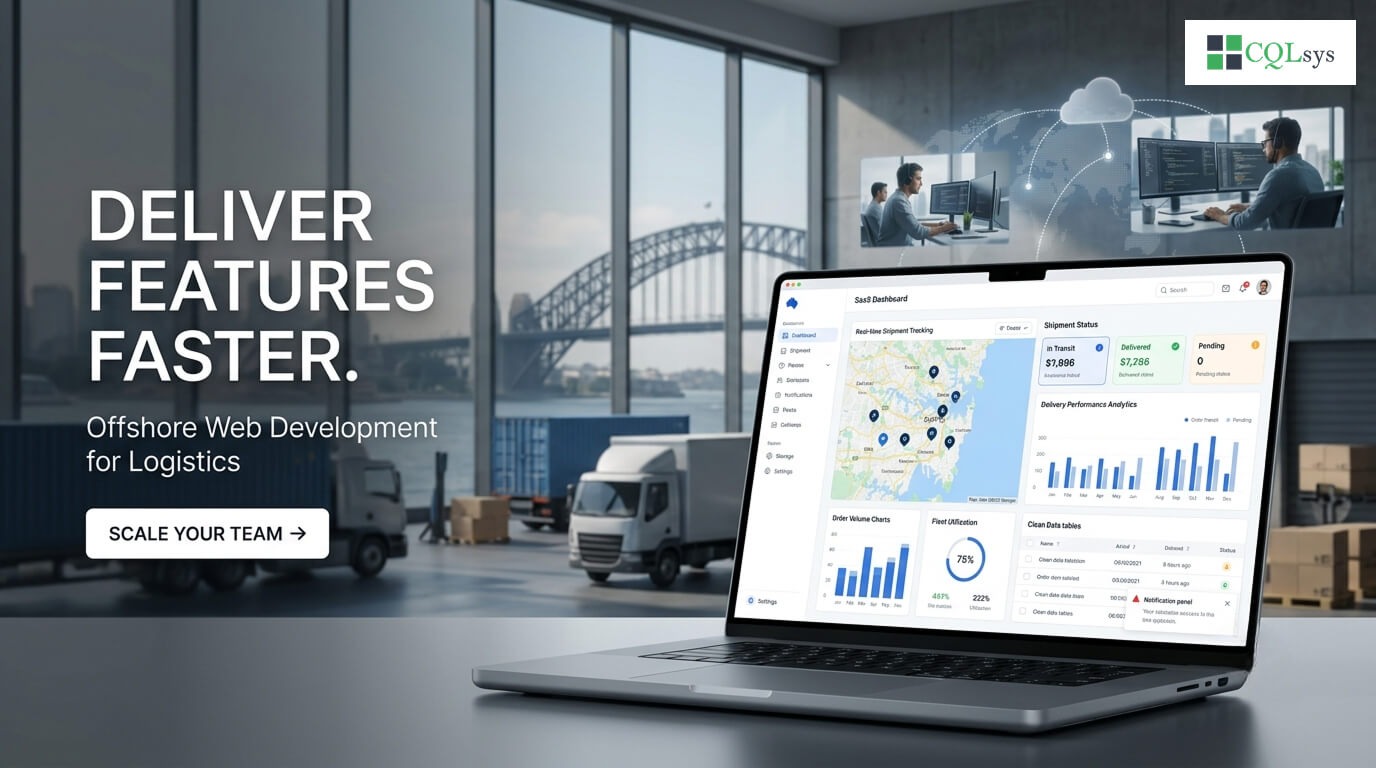
Offshore Web Development for Logistics Companies in Sydney: Deliver Features Faster Without Expanding Your Team
The freight, transport, and 3PL landscape across Greater Sydney, Port Botany, and Western Sydney's hub developments is moving at an unprecedented pace. Customer expectations for real-time visibility, automated dispatch, instant rate quoting, and seamless partner integrations have transformed software from a back-office tool into a core competitive asset.
However, Sydney transport leaders face a structural bottleneck: hiring local senior web engineers, solution architects, and full-stack developers is expensive, slow, and hyper-competitive. High local developer rates combined with long recruitment cycles threaten digital transformation initiatives.
To maintain market leadership and accelerate software roadmaps, forward-thinking Australian supply chain leaders are adopting offshore web development strategies. Partnering with specialized offshore technology consultancies allows freight forwarders, 3PL providers, and transport operators to build custom digital solutions, eliminate feature backlogs, and achieve high software throughput without adding internal overhead.
1. The Sydney Supply Chain Pressures Driving Offshore IT Adoption
Operating a logistics business in New South Wales involves unique cost pressures, strict SLAs, and intense regional competition. As major infrastructure projects expand distribution capabilities across Western Sydney, supply chain firms are pressured to digitize operations end-to-end.
- Engineering Shortages and Cost Constraints: Local Sydney developer salaries remain among the highest globally. Sourcing full-stack engineers with domain experience in freight, telematics, or fleet management can take three to six months, burning valuable time while roadmaps stall.
- Rapid Shift to Digital-First Freight Operations: Shippers and commercial clients no longer tolerate manual spreadsheets, phone updates, or delayed POD (Proof of Delivery) processing. They expect customer-facing web portals, real-time shipment maps, automated invoicing, and instant exception alerts.
- Legacy Systems Blocking Growth: Many Sydney transport companies run on legacy desktop software or outdated databases. Modernizing these enterprise platforms into responsive, cloud-native web applications requires technical bandwidth that internal IT teams simply cannot supply while handling daily operational tickets.
- Scalability for Peak Seasons: Supply chain activity fluctuates sharply around peak retail periods and import cycles. Expanding local headcount during demand surges creates financial drag during off-peak windows, whereas an offshore framework delivers flexible elasticity.
Outsourcing web development to an experienced offshore technology partner grants immediate access to skilled software engineers who understand supply chain workflows. By leveraging specialized external teams, Sydney logistics companies can clear engineering backlogs, modernize legacy tools, and launch new commercial services months ahead of competitors.
2. Essential Web Applications Transforming Sydney Freight and 3PL Operations
Modern supply chain web portals must serve multiple internal and external stakeholders, providing clear data flow and responsive performance across desktop and mobile devices. Offshore development teams build tailored systems designed for critical freight functions:
- Customer Self-Service Portals: B2B portals allowing shippers to request instant freight quotes, book consignments, generate labels, monitor real-time GPS movements, and access proof-of-delivery documents without phone intervention.
- Driver & Carrier Dispatch Web Dashboards: Centralized management consoles for dispatchers to assign routes, monitor driver status, handle dynamic re-routing, track fuel efficiency, and automate run sheets in real time.
- 3PL Warehouse Management (WMS) Web Dashboards: Intuitive web interfaces for multi-tenant inventory tracking, automated pick-and-pack workflows, cross-dock management, and real-time stock level synchronization with enterprise e-commerce platforms.
- Freight Forwarding & Customs Portals: Web solutions engineered to digitize air and ocean freight documentation, track container movements through port terminals, streamline customs clearance tracking, and manage complex multi-modal shipments.
- Subcontractor & Carrier Marketplaces: Secure platforms where freight brokers can post unassigned loads, receive bids from vetted carrier networks, evaluate rate structures, and issue digital rate confirmations automatically.
3. How Sydney Firms Build High-Performing Offshore Engineering Teams
Transitioning to an offshore web development model does not mean giving up quality, control, or security. Successful Sydney transport companies follow structured operational models that integrate external engineers directly into their technical workflows.
Team Structuring Options
- Dedicated Team Augmentation: Offshore full-stack web developers, frontend specialists, and QA engineers integrate directly into your internal IT management structure, attending daily standups and using your preferred issue-tracking platforms.
- End-to-End Managed Project Delivery: An offshore technology team assumes full responsibility for building a specific web platform or portal from initial discovery through architecture, design, development, security testing, and cloud deployment.
- Hybrid Onsite-Offshore Architecture: Local Sydney product owners or solution architects handle high-level business strategy and stakeholder alignment, while offshore engineering squads handle hands-on software development, testing, and system integration.
Overcoming Timezone and Collaboration Barriers
A 2 to 3-hour time difference between Sydney and prominent IT export hubs like India provides an operational advantage rather than a barrier.
Overlapping business hours allow for daily syncs, sprint planning, and architectural reviews. Remaining hours create a continuous development loop: your Sydney team identifies business specifications or logs feedback during Australian business hours, and the offshore team implements and tests updates overnight. This continuous cycle drastically reduces time-to-market for major feature releases.
4. High-Level Solution Architecture for Logistics Web Platforms
A resilient enterprise web platform for supply chain management requires modularity, high availability, strict security, and real-time processing capabilities. Modern web architecture isolates distinct layers to ensure system performance under heavy API loads or sudden order spikes.
End-to-End System Flow
- Step 1: User & Presentation Layer — Shippers, carriers, drivers, and administrators interact with specialized portals and mobile web interfaces built using responsive frameworks.
- Step 2: Security & Routing Layer — Requests pass through Web Application Firewalls, API Gateways, and OAuth2 authentication to ensure verified access and role control.
- Step 3: Application & Services Layer — Dedicated microservices handle rate calculations, shipment tracking engines, order dispatch logic, and warehouse management rules.
- Step 4: Integration & Messaging Layer — An event bus processes incoming EDI transactions, REST APIs, and high-frequency messaging data in real time.
- Step 5: Data & External Systems Layer — Scalable databases and in-memory caches handle transactional records, while connecting directly to telematics platforms and legacy ERP systems.
Key Architectural Layers Explained
- User & Presentation Layer: Responsive web interfaces built using modern frontend frameworks like React or Next.js. Optimized for fast rendering on mobile devices used by warehouse personnel or transport operators on site.
- Security & Routing Layer: Enterprise-grade security handling traffic routing, Web Application Firewall (WAF) protection, DDoS mitigation, and centralized access control using standard OAuth2 and Role-Based Access Control (RBAC).
- Application & Services Layer: Business logic executed as microservices or modular monoliths. Core engines process rate calculations, automated shipment assignment, dynamic routing optimization, and automated customer notifications.
- Integration & Messaging Layer: Event-driven architecture utilizing message brokers to ensure asynchronous communications between third-party systems. Handles high-volume EDI transactions, telematics streams, and ERP database updates without degrading portal performance.
- Data & External Systems Layer: Scalable primary relational databases combined with high-performance memory caches for quick session access and vehicle coordinate processing. Encrypted interfaces link directly to third-party telematics providers, port authority databases, and financial systems.
5. Modern Technology Stack Selection
Building web applications for transport and supply chain demands reliable technology choices. Offshore teams select frameworks based on performance, ecosystem maturity, maintainability, and enterprise adoption.
| Component Layer | Recommended Technologies | Purpose & Business Value |
|---|---|---|
| Frontend Framework | React.js, Next.js, Vue.js | Delivers responsive user interfaces with rapid state updates for real-time tracking dashboards. |
| Backend Framework | Node.js (TypeScript), Python (FastAPI), .NET Core | Handles high concurrency, real-time message handling, and complex supply chain business rules efficiently. |
| Database Systems | PostgreSQL, MongoDB, Redis | Combines structured transactional safety for invoicing with document storage for freight manifests and fast in-memory caching for live GPS tracking. |
| Cloud Infrastructure | Amazon Web Services (AWS), Microsoft Azure | Ensures cloud reliability, auto-scaling during demand peaks, and local Australian cloud hosting region selection for compliance. |
| Integration & Messaging | Apache Kafka, RabbitMQ, REST, GraphQL | Manages real-time data streaming from IoT tracking devices, telematics sensors, and enterprise EDI platforms. |
| DevOps & Security | Docker, Kubernetes, GitHub Actions, HashiCorp Vault | Automates deployment pipelines, ensures infrastructure stability, and manages sensitive API credentials securely. |
6. Strategic Comparison: Local Hiring vs. Offshore Web Engineering
To make informed outsourcing decisions, Sydney executive teams must evaluate costs beyond direct developer hourly rates. Total cost of ownership, speed to market, and operational flexibility are critical variables.
| Evaluation Metric | In-House Sydney Engineering Team | Offshore Engineering Team Partnership |
|---|---|---|
| Sourcing & Onboarding Time | 3 to 6 months per key engineering role | 1 to 3 weeks for full team deployment |
| Direct Overhead Costs | High base salaries, superannuation, office space, hardware, payroll taxes | Transparent hourly or monthly team engagement rates |
| Capacity Elasticity | Fixed team size; difficult and costly to adjust during market downturns | Flexible capacity; scale developers up or down based on product roadmap milestones |
| Technology Coverage | Limited to the specific skill set of hired local employees | Access to specialists across cloud infrastructure, AI automation, cybersecurity, and legacy migration |
| Time-to-Market Speed | Constrained by local capacity and recruiting bottlenecks | Rapid feature releases driven by dedicated offshore resources working continuous cycles |
| Risk Management | Key person dependency; high risk if local senior developers leave | Distributed team structures with structured technical documentation and shared domain knowledge |
7. Cost, ROI, and Measurable Business Impact
Outsourcing web application engineering to offshore teams converts heavy fixed capital expenditure into predictable operational expenditure. This shift generates clear financial and operational advantages for Sydney freight operators:
- Significant Engineering Savings: Offshore engagement models cut direct web engineering costs by 40% to 60% compared to local Sydney hiring, freeing capital for fleet upgrades or marketing.
- Reduced Development Cycles: Dedicated offshore teams focus entirely on sprint goals without back-office operational distractions, allowing companies to launch web modules months ahead of schedule.
- Lower Error Rates via Automation: Replacing manual dispatch spreadsheets, physical POD handling, and manual billing entry with integrated web software minimizes human error, cuts administrative overhead, and accelerates billing cycles.
- Improved Client Retention: Shippers prefer transport partners that offer clear digital interfaces, real-time tracking, and simple API integrations. A modern digital platform acts as a major differentiator during commercial enterprise tenders.
8. Data Security and Australian Compliance Standards
Transport and supply chain applications manage sensitive commercial data, such as customer pricing tiers, shipment manifests, warehouse values, and personal recipient info. When working with offshore engineering partners, Sydney logistics companies must ensure strict data security practices:
- Data Residency Compliance: Ensuring primary application databases and customer information are hosted in local Australian cloud data center regions (e.g., AWS Sydney ap-southeast-2 or Azure Australia East) to satisfy data governance mandates.
- Australian Privacy Principles (APPs): Aligning software architecture and user access models with the Privacy Act 1988, ensuring explicit data encryption at rest and in transit.
- Role-Based Access Control (RBAC): Restricting application access through secure authentication patterns, ensuring third-party drivers, subcontractors, and external clients access only their relevant data segments.
- Continuous Vulnerability Management: Incorporating automated code security checks into deployment pipelines to block code vulnerabilities before release.
- Strict Non-Disclosure Agreements (NDAs): Establishing legally sound intellectual property protection frameworks that explicitly assign all software rights, repository access, and patents directly to the Sydney client company.
9. Implementation Roadmap: From Strategy to Deployment
A structured implementation path ensures that offshore web development projects deliver measurable business outcomes without disrupting day-to-day freight operations.
- Phase 1: Discovery & Audit (Weeks 1–2)
- Define system specifications and audit current freight workflows.
- Identify integration requirements with existing ERP or WMS platforms.
- Establish core project milestones and performance indicators.
- Phase 2: Architecture & Security Blueprint (Weeks
3–4)
- Design application infrastructure and database access models.
- Create user experience prototypes for dispatcher and shipper portals.
- Select technology stack components and define API contracts.
- Phase 3: Iterative Agile Development (Weeks
5–14)
- Execute bi-weekly engineering sprints for rapid feature output.
- Build core modules including tracking engines, booking forms, and dispatch screens.
- Maintain regular sprint reviews and progress demonstrations.
- Phase 4: Security Testing & UAT (Weeks
15–17)
- Perform complete integration testing across all third-party APIs.
- Run simulated load tests on telematics and order processing queues.
- Execute User Acceptance Testing (UAT) with key operations personnel.
- Phase 5: Production Launch (Week 18+)
- Deploy application instances into secure Australian cloud environments.
- Execute a phased migration schedule to onboard pilot clients smoothly.
- Monitor active database operations and system performance.
- Phase 6: Continuous Support & Optimization
(Ongoing)
- Track system usage metrics and collect user feedback.
- Release iterative feature updates based on operational requirements.
- Maintain continuous cloud health monitoring and security patching.
10. Why Choose CQLsys Technologies for Sydney Logistics Web Development?
As an enterprise technology partner specializing in web and mobile applications, CQLsys Technologies builds scalable software solutions that enable logistics and supply chain providers to innovate faster and reduce operational drag.
- Deep Supply Chain Engineering Capabilities: We understand complex transport ecosystems, including multi-tier dispatch logic, EDI messaging, vehicle telematics integrations, and custom warehouse management interfaces.
- Flexible Delivery & Augmentation Models: Whether you need dedicated full-stack developers to extend your internal team or complete end-to-end management of a supply chain portal project, we offer flexible engagement models tailored to your requirements.
- Focus on Modern Web Architecture: Our developers design secure, high-performance web systems using frameworks like React, Node.js, Python, and enterprise cloud infrastructure, ensuring your platforms scale smoothly as shipment volumes increase.
- Transparent Communication Protocols: We operate with complete visibility, maintaining aligned overlapping working hours, agile sprint reporting, and clear documentation. Your team retains full control over all code repositories and project assets.
Discover how our tailored web development services and dedicated engineering teams can help your company ship software features faster. Learn more about our technical approach on our about us page.
11. Frequently Asked Questions (FAQs)
1. How can Sydney logistics providers deliver features faster with offshore teams?
Offshore web development teams provide immediate engineering bandwidth, bypassing the long recruitment cycles common in the local Sydney market. Dedicated offshore squads work focused agile sprints to clear development backlogs and build custom portals, rate calculators, or dispatch applications faster.
2. What are the benefits of offshore web development for Sydney supply chain firms?
Key benefits include 40% to 60% savings on development costs, access to specialized software engineering talent, flexible capacity during peak freight cycles, faster release times, and the ability to modernize legacy IT systems without expanding internal overhead.
3. How do offshore teams ensure compliance with Australian data laws?
Reputable offshore partners configure applications to host all production data within local Australian cloud regions (such as AWS Sydney). Developers follow Australian Privacy Principles (APPs), apply strict data encryption standards, and implement role-based access controls to maintain compliance.
4. What is the cost difference between local Sydney hiring and offshore development?
Hiring senior full-stack developers in Sydney involves high salaries, recruitment fees, superannuation, office space, and payroll taxes. Offshore development models provide access to engineers at lower hourly rates with zero recruiting overhead, transforming large capital outlays into predictable operational expenses.
5. Can an offshore web team integrate with our existing WMS and TMS?
Yes. Experienced offshore engineers build secure RESTful APIs, GraphQL endpoints, and custom EDI middleware. This enables modern customer web portals to exchange real-time data seamlessly with legacy WMS, TMS, and enterprise ERP systems.
6. How do you manage timezone differences between Sydney and offshore teams?
The 2 to 3-hour time difference between Sydney and key offshore engineering hubs like India allows for overlapping work hours each day. This window is used for daily standups, architectural reviews, and sprint planning, while off-hours create an overnight development cycle that accelerates project turnaround.
7. What technologies are best for modern freight and 3PL web portals?
Modern web portals typically utilize React or Next.js on the frontend for responsive interfaces, paired with Node.js, Python, or .NET Core on the backend. PostgreSQL and MongoDB handle data storage, Redis manages fast caching, and cloud platforms like AWS provide scalable hosting.
8. How do offshore developers maintain high security for supply chain data?
Offshore teams use multi-factor authentication, end-to-end data encryption, automated security scans within deployment pipelines, Web Application Firewalls (WAF), and strict Role-Based Access Control (RBAC). Furthermore, non-disclosure agreements ensure all intellectual property rights remain strictly with the client.
9. What features should a custom Sydney logistics web portal include?
Essential features include real-time consignment tracking, automated rate quote generators, online booking engines, driver dispatch consoles, proof of delivery (POD) upload management, automated customer notifications, and comprehensive financial reporting dashboards.
10. Why choose CQLsys Technologies for Sydney logistics web development?
CQLsys Technologies brings extensive experience in custom web development, supply chain software integrations, and enterprise cloud solutions. We provide dedicated development teams, complete project ownership, transparent agile processes, and continuous technical support designed to help logistics providers scale efficiently.
12. Accelerate Your Logistics Web Roadmap with CQLsys
Don't let engineering bottlenecks slow your digital transformation. Partner with an experienced technology partner to ship features faster, modernize your supply chain portals, and gain a competitive edge in the Sydney market.
Ready to scale your web development capacity?
Contact Our
Technology Consultants Today
- Email: info@cqlsys.com
- Website: https://www.cqlsys.com/
- Follow Us: LinkedIn | Facebook | Instagram