White-Label Software Development for FinTech Companies in New York: Scale Your Team Without Hiring More Engineers
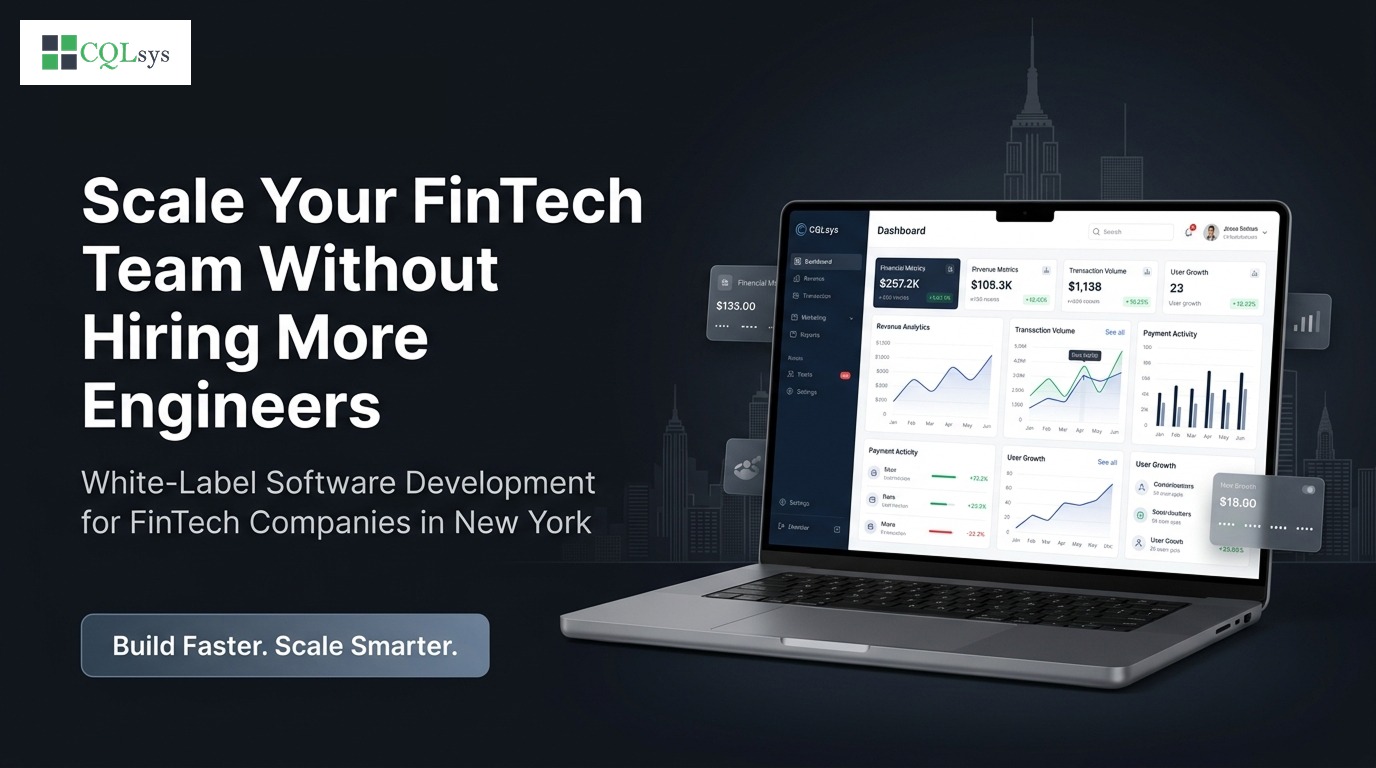
New York City remains the capital of global finance, driving rapid innovation across institutional banking, capital markets, wealth management, and decentralized finance. However, for technology leaders navigating the Wall Street ecosystem and Silicon Alley, maintaining software engineering momentum presents an ongoing structural hurdle. Sourcing, hiring, and retaining senior financial technology engineers in Manhattan or Brooklyn demands substantial capital and lengthy recruitment lifecycles.
To overcome these constraints, institutional leaders are adopting white-label software development for FinTech companies in New York. By leveraging dedicated external engineering teams, financial platforms can scale product roadmaps, deploy cloud-native infrastructure, and launch proprietary features under their own brand—all while avoiding the delay and overhead of expanding local headcount.
Partnering with an experienced financial software development partner provides immediate access to specialized expertise in high-throughput transaction processing, open banking APIs, real-time analytics, and enterprise-grade security architectures.
The New York FinTech Talent Bottleneck
The financial technology sector in New York operates under intense competitive pressure. Engineering executives face three distinct operational challenges:
- Extreme Talent Acquisition Costs: The fully burdened cost of a senior FinTech developer in New York City—factoring in base salary, equity, benefits, payroll taxes, and real estate—regularly exceeds traditional compensation structures.
- Extended Hiring Cycles: Recruiting specialized engineers with domain expertise in compliance algorithms, ledger architecture, and payment gateways can require three to six months.
- Rapid Feature Depreciation: In fast-moving financial markets, prolonged delivery cycles mean losing ground to agile market entrants and institutional platforms.
Attempting to address these headwinds purely through traditional local recruitment frequently strains operating capital and slows product velocity.
Why White-Label Software Development Works for FinTechs
White-label software development allows financial institutions to leverage pre-built, production-ready backend frameworks or fully dedicated engineering teams that construct solutions directly to client specifications. The resulting technology is deployed under your company’s brand, user interface, and operational domain.
Complete Intellectual Property Ownership
Unlike off-the-shelf SaaS solutions that license software without transferring underlying assets, elite white-label agreements assign total IP ownership to your firm. Every line of code, database schema, and microservice integration becomes an asset on your corporate balance sheet.
Immediate Scalability
When launching a novel wealth management portal or an institutional payment processing module, white-label partnerships allow you to deploy dedicated development teams in days rather than quarters.
Operational Cost Efficiency
By utilizing off-site specialized engineering talent, financial firms reduce fixed operational overhead and convert unpredictable capital expenditure into manageable, predictable operational investments.
High-Level Solution Architecture for White-Label FinTech Platforms
To ensure performance, data integrity, and regulatory alignment, enterprise FinTech applications require a modular, distributed architecture.
Architecture Data Flow
End-User (Web/Mobile) → Web Application Firewall (WAF) / CDN → OAuth 2.0 / OIDC Identity Provider → API Gateway → Serverless & Microservices Core → Automated Compliance & Fraud Engine → Multi-Region Relational / NoSQL Database → External Financial Networks (ACH, SWIFT, Plaid)
System Component Breakdown
- User Experience Layer: Web Portal | Mobile App (iOS/Android) | Partner APIs
- Security & Access Layer: WAF / CDN | OAuth 2.0 / OIDC Auth | API Gateway
- Application Services Layer: Ledger Engine | Payments Core | Fraud AI | Compliance ML
- Data & Integration Layer: Multi-Region DB | Redis Cache | Core Banking / SWIFT / ACH
Architecture Layer Descriptions
User Experience Layer
Delivers responsive web interfaces and mobile applications custom-branded to your firm’s exact design system. Interfaces interact with backend systems strictly through secure, authenticated API calls.
Security & Access Layer
Integrates Web Application Firewalls (WAF), Distributed Denial of Service (DDoS) mitigation, and identity management frameworks using OAuth 2.0 and OpenID Connect (OIDC) to enforce Zero Trust security models.
Application & Microservices Layer
Deconstructs core financial operations into isolated microservices. Separate containers manage ledger entries, account reconciliation, payment routing, and automated compliance verification.
AI & Analytics Layer
Executes real-time transaction monitoring, anomaly detection, and fraud evaluation algorithms prior to finalizing transaction ledgers.
Data & Integration Layer
Utilizes ACID-compliant databases to guarantee financial record consistency, alongside encrypted cache layers for fast asset valuation and market data retrieval. External integrations establish secure links to core banking networks, SWIFT, clearing houses, and market data providers.
Key Enterprise Technology Stack
Selecting the correct architecture components ensures your white-label platform meets institutional performance expectations:
| Architecture Layer | Component Purpose | Enterprise Technology Selection |
|---|---|---|
| Frontend Platform | High-performance user interface | React, Next.js, Flutter, TypeScript |
| Backend Framework | High-concurrency transaction engine | Node.js, Python (FastAPI/Django), Go, Java |
| Database & Cache | Immutable financial ledgers & speed | PostgreSQL, Amazon Aurora, Redis, MongoDB |
| Cloud Infrastructure | High-availability financial hosting | AWS Financial Services, Microsoft Azure |
| Security & Auth | Identity management & API defense | Okta, AWS Cognito, HashiCorp Vault, Cloudflare |
| CI/CD & Containers | Automated deployment pipelines | Docker, Kubernetes, Terraform, GitHub Actions |
In-House Hiring vs. White-Label Development Partnership
| Evaluation Category | Internal Local Hiring (NYC) | White-Label Engineering Partner |
|---|---|---|
| Time to Onboard | 3 to 6 Months | 1 to 3 Weeks |
| Fully Burdened Cost | High (Base + Equity + Overhead) | Scalable, Project/Retainer-based |
| Regulatory Knowledge | Dependent on individual hires | Built-in team compliance expertise |
| IP Ownership | Internal Direct | Full Transfer via Explicit Agreement |
| Scaling Flexibility | High friction during downsizing | Elastic scaling based on project roadmap |
| Maintenance & Support | Internal responsibility | Managed SLAs available |
Primary FinTech Use Cases for White-Label Platforms
- Digital Banking & Neobanking: Launch branded checking, savings, and card issuance platforms backed by secure core banking integrations, multi-factor authentication, and native mobile applications.
- Wealth & Investment Management: Deploy customer portals for asset management, automated portfolio rebalancing, real-time market tracking, and custodial API connections.
- Payment Gateways & Merchant Processing: Build branded payment processing infrastructure supporting multi-currency transactions, automated reconciliation, and tokenized PCI-DSS compliant credit card processing.
- Digital Lending & Credit Underwriting: Implement automated loan origination platforms, integration with credit bureaus, algorithmic risk profiling, and automated document verification.
Security, Compliance, and Regulatory Governance
Financial software operating within New York must satisfy rigorous regulatory frameworks. White-label architectures must be built from the ground up to comply with global and regional mandates:
- NYDFS Part 500: Multi-Factor Auth, Encryption, Audit Logs
- PCI-DSS Level 1: Payment Tokenization & Vaulting Architecture
- SOC 2 Type II: Continuous Monitoring & Access Controls
NYDFS Cybersecurity Regulation (23 NYCRR Part 500)
New York-regulated financial institutions must implement strict cybersecurity policies, including mandatory multi-factor authentication, robust encryption standards for data at rest and in transit, continuous audit logging, and periodic vulnerability assessments.
PCI-DSS Level 1 Compliance
Payment infrastructure processing cardholder data must utilize tokenization and secure vaulting mechanisms to ensure personal financial data never touches unauthorized application servers.
SOC 2 Type II Certification Standards
Engineering processes must conform to rigorous operational controls governing system availability, processing integrity, data confidentiality, and privacy safeguards.
Strategic Implementation Roadmap
Transitioning to an external white-label engineering partner requires structured execution to maintain delivery momentum and code security:
- Phase 1 — Discovery & Architecture Definition (Weeks 1-2): Analyze business requirements, document API contracts, select technical stack components, and establish concrete milestone objectives.
- Phase 2 — Security, Governance & IP Agreements (Weeks 2-3): Finalize non-disclosure agreements, legal IP transfer frameworks, data protection protocols, and secure code repository access rights.
- Phase 3 — Core Module Customization & API Integration (Weeks 4-10): Configure backend microservices, apply custom UI/UX design systems, and integrate core financial networks and databases.
- Phase 4 — Quality Assurance & Penetration Testing (Weeks 10-12): Execute automated unit, integration, stress, and security testing, including third-party penetration audits to ensure zero critical vulnerabilities.
- Phase 5 — Managed Deployment & Continuous SLA Support (Ongoing): Deploy applications to production cloud environments, monitor live transaction performance, and maintain ongoing operational support SLAs.
Why Partner with CQLsys Technologies?
Scaling enterprise technology demands an engineering partner with a proven track record of delivering resilient financial solutions. CQLsys Technologies provides high-performing engineering teams tailored to the demands of modern FinTech enterprises.
Enterprise Engineering Capabilities
- Enterprise Web Development & Scalable Cloud Solutions
- Native & Cross-Platform Mobile App Architectures
- Specialized Financial Software Development & System Integration
- AI-Driven Fraud Detection & Algorithmic Automation
Our Deep Technology Domain Expertise Includes:
- Dedicated engineering teams capable of integrating directly into your agile workflows.
- Custom backend and API architectures built to meet NYDFS and PCI-DSS compliance standards.
- Expertise across cloud-native environments, modern JS/TypeScript frameworks, and high-concurrency microservices.
- Comprehensive IP protection with complete transfer of source code rights upon project completion.
Frequently Asked Questions
1. How does white-label software development work for NYC FinTechs?
White-label software development provides pre-engineered or custom-built financial software modules that are tailored, branded, and deployed under your firm's identity. This allows New York financial institutions to launch custom applications quickly while retaining full ownership of source code and intellectual property.
2. Can white-label software meet NYDFS compliance standards?
Yes. When developed by an experienced software engineering partner, white-label applications are constructed around NYDFS 23 NYCRR Part 500 requirements. This includes implementing data encryption at rest and in transit, multi-factor authentication, granular access controls, and detailed audit logging capabilities.
3. Who retains intellectual property rights in white-label development?
Under CQLsys Technologies' white-label agreements, 100% of the intellectual property, source code, and design assets are fully transferred to your company upon project completion, ensuring your internal technical assets build long-term enterprise value.
4. How quickly can a white-label team integrate with our NYC firm?
While traditional local engineering recruitment takes three to six months, a dedicated white-label software team can be onboarded and active within one to three weeks, significantly accelerating your product delivery schedule.
5. What is the cost difference between local hiring and white-label engineering?
Hiring senior FinTech software engineers in New York City involves high base salaries, equity distribution, benefits, and operational real estate overhead. White-label partnerships convert high fixed employment overhead into flexible, predictable operational investments, delivering substantial cost efficiency.
6. How do white-label engineering teams maintain security and data protection?
White-label platforms utilize institutional security controls, including Zero Trust access frameworks, encrypted API communications, continuous vulnerability monitoring, isolated database environments, and adherence to SOC 2 Type II operational protocols.
7. Can white-label FinTech platforms be customized with proprietary UI/UX?
Yes. Every front-end interface, user workflow, and visual component is fully customized to reflect your brand guidelines and corporate design system, providing a seamless user experience across web and mobile applications.
8. What technologies are best suited for enterprise white-label FinTech builds?
High-performing FinTech platforms typically leverage modern, scalable frameworks such as Node.js, Python, Go, and Java on the backend, paired with React, Next.js, or Flutter on the frontend, supported by AWS or Azure financial cloud infrastructure.
9. What is the difference between white-label software and traditional IT outsourcing?
Traditional IT outsourcing often focuses on temporary staff augmentation or tactical bug fixes. White-label software development delivers complete end-to-end product modules, architecture ownership, explicit legal IP transfer, and dedicated engineering leadership aligned with your corporate product roadmap.
10. How do we maintain quality control over an external white-label engineering team?
Quality control is maintained through direct integration with your internal technical leadership, daily agile standups, transparent Git code repositories, continuous integration pipelines, automated test coverage metrics, and strict SLA commitments.
Accelerate Your FinTech Product Roadmap
Ready to expand your software engineering capacity without the friction of local hiring? Partner with CQLsys Technologies to build secure, scalable, enterprise-grade financial platforms engineered for growth.