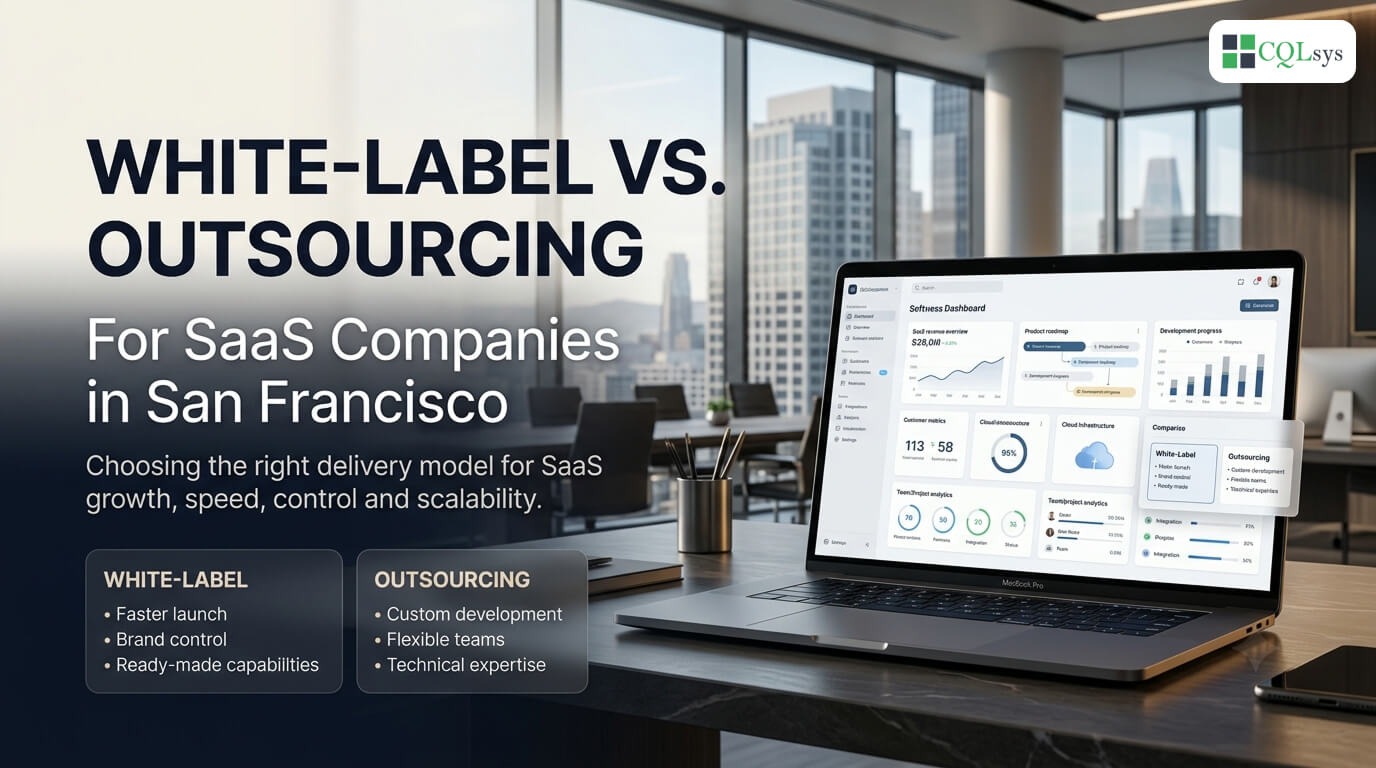
White-Label vs. Outsourcing for SaaS Companies in San Francisco: Which Model Delivers Better ROI in 2026?
1. Executive Context & Industry Reality
San Francisco remains the epicenter of Software-as-a-Service (SaaS) innovation, but operating within the Bay Area ecosystem presents unprecedented capital challenges in 2026. With fully burdened compensation packages for senior local full-stack engineers frequently exceeding $280,000 to $350,000 annually, technology leaders face enormous pressure to scale SaaS product development without hiring locally for every position. Founder and executive teams must navigate tighter venture capital deployment cycles, demanding immediate capital efficiency, high gross margins, and rapid feature execution.
Core ROI Takeaway: White-label models minimize upfront capital expenditures and deliver immediate time-to-market advantages, making them ideal for rapid market testing. Conversely, custom software outsourcing creates proprietary technical IP, superior long-term gross margins, and enterprise valuation expansion as software scale increases.
2. The San Francisco SaaS Operating Landscape in 2026
Building a scalable software enterprise in the San Francisco Bay Area requires balancing technical performance with fiscal discipline. Executive teams encounter structural dynamics that make reliance on strictly internal, local engineering talent economically unsustainable during growth phases:
- Capital Conservation & Burn Rate Management: Modern SaaS investors prioritize sustainable growth and positive unit economics over unconstrained burn. High Bay Area engineering compensation places massive pressure on runway metrics.
- Talent Scarcity & High Churn: Recruiting senior engineers in San Francisco involves long hiring cycles and high retention bonuses. Software engineering costs in the Bay Area force leadership to look outside local markets.
- Velocity Demands: Enterprise customers expect rapid feature delivery, continuous integration, and immediate compliance adherence (such as SOC 2 Type II and ISO 27001). Delaying a product release by two quarters can permanently compromise market positioning.
- Feature Breadth Expansion: B2B platforms must offer comprehensive integrations, workflow automation, and analytics suites out of the box to compete effectively.
3. Defining the Execution Models: White-Label vs. Software Outsourcing
To evaluate return on investment accurately, executive decision-makers must establish clear definitions of these two delivery frameworks.
The White-Label Model
The white-label model involves licensing an existing, fully built software application or modular engine created by a third-party vendor. The SaaS company rebrands the platform, applies custom domain routing, configures visual styling, and presents it to end clients as a proprietary application. This strategy relies heavily on multi-tenant architecture managed by an external provider.
The Custom Software Outsourcing Model
Custom software development outsourcing involves engaging a specialized technology partner to engineer bespoke software components, features, or complete applications. Under this framework, your company retains 100% intellectual property ownership. The external team operates as an extension of your internal product office, building custom SaaS feature pipelines that directly align with your long-term product roadmap.
4. Direct Comparison Matrix: White-Label vs. Outsourcing
The table below provides a side-by-side comparative analysis across core operational, financial, and technical parameters for Bay Area software companies.
| Strategic Metric | White-Label Software Platform | Custom Software Outsourcing |
|---|---|---|
| Time to Market | Ultra-Fast (1 to 4 weeks) | Moderate (8 to 20 weeks) |
| Upfront Development Cost | Low (Licensing & Setup Fees) | Moderate to High (Initial Build Phase) |
| Intellectual Property (IP) | None (Third-party retains source code) | 100% Client Ownership (Full Proprietary IP) |
| Long-Term Gross Margins | Capped by per-seat/volume license costs | High (Cost decreases per user at scale) |
| Customization & Flexibility | Restricted to vendor API and configuration limits | Unlimited (Fully custom software architecture) |
| Vendor Lock-in Risk | High (Platform dependent) | Low (Source code & infrastructure fully transferable) |
| Enterprise Valuation Impact | Lower multiple (Reseller / Service profile) | Higher multiple (Proprietary tech IP asset) |
| Maintenance & Security Updates | Managed by platform vendor | Managed via SLA with outsourcing partner |
5. High-Level Enterprise Solution Architecture
Modern B2B SaaS applications operating out of San Francisco frequently deploy a hybrid architecture. This enables companies to incorporate white-label functional modules (such as reporting engines or workflow tools) while maintaining a core proprietary microservices backend developed through custom software outsourcing.
| Stage / Architectural Layer | Components & Technologies | Key Functions & Features | Ownership & Integration Model |
|---|---|---|---|
| Entry & Perimeter Security | Users / Clients | End-user interaction and client requests | External access point |
| Edge & Protection Layer | Cloudflare CDN / WAF | Content delivery, DDoS mitigation, and Web Application Firewall security | Global edge protection |
| Gateway & Access Control | API Gateway / OAuth 2.0 Security Layer | Request routing, rate limiting, token validation, and authorization | Central security boundary |
| Proprietary Core Services |
• Core Business Logic & Algorithms • Account Management & Billing • PostgreSQL / Redis Cache |
Primary application processing, user subscription handling, data persistence, and high-speed caching | Custom Outsourcing (100% IP Ownership) |
| White-Label Module Integration |
• Embedded Analytics / Reports • Standard Communication Hub • Webhook Sync Layer |
Reusable components, third-party messaging, dynamic reporting, and event-driven data synchronization | Multi-Tenant Vendor API |
| Data Governance & Audit | Enterprise Analytics & Audit Log | System monitoring, compliance auditing, operational tracking, and aggregated intelligence | Enterprise-wide central log |
Architectural Component Breakdown
- Security & Experience Layer: Incoming traffic flows through Cloudflare Web Application Firewall (WAF) and an API Gateway enforcing OAuth 2.0 authentication and rate limiting to safeguard user requests.
- Proprietary Application Layer (Outsourced Build): Houses core business logic, proprietary data pipelines, and custom customer features built by a dedicated software engineering team offshore. Managed via containerized microservices running on Kubernetes.
- Integration Layer (White-Label Integration): Connects via secure RESTful APIs and webhooks to third-party white-label services, enabling standard ancillary capabilities without burdening internal core engineering resources.
- Unified Data Layer: Separates proprietary customer data stored in isolated PostgreSQL instances from cached session states managed in Redis clusters.
Architecture Component & Technology Alignment
| Architecture Layer | Operational Role | Recommended Enterprise Technology |
|---|---|---|
| Frontend Interface | User Experience & Dashboards | React, Next.js, TypeScript, Tailwind CSS |
| Core Services Backend | Proprietary Business Logic | Node.js, Python (FastAPI / Django), Go |
| API & Security Layer | Traffic Routing & Authentication | Kong API Gateway, OAuth 2.0, Auth0, AWS WAF |
| Database & Cache | Multi-tenant Data Management | PostgreSQL, MongoDB, Redis Cluster |
| Cloud Infrastructure | Scalable Execution Environment | AWS (EKS, Aurora), Google Cloud Platform |
6. Comprehensive Cost & ROI Analysis for 2026
Evaluating White-Label vs. Outsourcing for SaaS Companies in San Francisco requires analyzing both short-term operational expenses and multi-year valuation trajectories. The total cost of ownership (TCO) shifts dramatically as customer volume expands.
Year 1 to Year 3 Capital Expenditure Breakdown
A typical San Francisco B2B SaaS startup aiming to launch an enterprise application faces distinct financial paths under each execution model:
- White-Label Financial Trajectory: Year 1 setup costs range between $15,000 and $45,000, with monthly recurring platform licensing fees of $3,000 to $8,000. However, as active user volumes scale, per-seat licensing escalates rapidly. By Year 3, annual licensing fees can exceed $180,000, while product differentiation remains constrained by vendor capabilities.
- Custom Outsourcing Financial Trajectory: Initial custom engineering via a dedicated offshore technology partner requires an upfront investment ranging from $60,000 to $140,000 depending on complexity. Subsequent maintenance, continuous integration, and feature releases average $4,000 to $8,000 monthly. By Year 3, unit costs decline significantly per active user, protecting SaaS gross margins above 80%.
Valuation Impact: Institutional investors in the Bay Area apply significantly higher enterprise value multiples (10x–18x ARR) to companies owning proprietary source code compared to businesses operating on white-label infrastructure (3x–6x ARR), which are often classified as tech-enabled brokerages or reseller services.
7. Security, Compliance & Risk Management
San Francisco SaaS enterprises serving fintech, healthcare, legal, or enterprise corporate clients face stringent compliance mandates. Technical decision-makers must rigorously evaluate security risk profiles across both delivery models.
- Data Governance & Privacy: Custom outsourcing allows full control over data storage regions, encryption keys (AES-256 at rest, TLS 1.3 in transit), and isolated database schemas. White-label platforms often store multi-tenant data in shared environments, introducing third-party exposure risks.
- Regulatory Adherence: Custom builds allow software engineers to embed SOC 2 Type II controls, GDPR compliance hooks, and HIPAA-compliant data pipelines directly into the source code. White-label compliance depends entirely on the vendor's audit schedules.
- Intellectual Property Security: When engaging an offshore development partner, enforce strict Non-Disclosure Agreements (NDAs), assign all IP rights to the parent company upon code check-in, and manage access via central Zero Trust Network Access (ZTNA) protocols.
8. Strategic Implementation Roadmap
Executing a successful development or integration program requires a phased operational structure. The following 6-phase roadmap guides SaaS companies through evaluating, building, and deploying software components securely.
- Phase 1 — Requirements & IP Blueprinting (Weeks 1–2): Define core proprietary features versus standard functional requirements. Conduct a gap analysis to decide between white-label modules or custom software outsourcing.
- Phase 2 — Vendor Selection & NDA Execution (Weeks 3–4): Audit software outsourcing partners or white-label providers for SOC 2 compliance, technical expertise, and developer capabilities. Finalize IP ownership contracts.
- Phase 3 — Solution Architecture & UX Design (Weeks 5–8): Design API integration frameworks, multi-tenant database schemas, and wireframes. Establish CI/CD pipelines and security protocol controls.
- Phase 4 — Sprint Execution & Core Development (Weeks 9–16): Run bi-weekly Agile development sprints. Implement automated unit testing, code reviews, and integration routines.
- Phase 5 — Security Auditing & UAT (Weeks 17–18): Perform penetration testing, static/dynamic security checks, and User Acceptance Testing (UAT) with target customer groups.
- Phase 6 — Deployment & Continuous Scaling (Weeks 19+): Roll out applications via containerized cloud infrastructure. Monitor system metrics and launch continuous feature iterations.
9. Why Choose CQLsys Technologies?
Navigating complex technical software delivery models requires a seasoned technology partner who understands both business requirements and modern software architecture. CQLsys Technologies delivers enterprise-grade IT consulting and custom software development tailored to high-growth tech companies worldwide.
Our global engineering teams empower San Francisco SaaS leadership to accelerate development velocity while maintaining strict capital efficiency. Whether you need an API-first multi-tenant platform, custom mobile applications, or high-throughput cloud backends, our dedicated development teams work as a seamless extension of your in-house product group.
- Full IP Ownership: 100% of the source code, architecture blueprints, and intellectual property belong exclusively to your business.
- Enterprise Compliance & Security: We build applications adhering strictly to SOC 2, ISO 27001, HIPAA, and GDPR standards.
- Scalable Talent Delivery: Expand your engineering capacity with senior full-stack developers skilled in React, Node.js, Python, AWS, and modern AI/ML frameworks without Bay Area recruitment friction.
- Transparent Agile Operations: Maintain full visibility over sprint velocity, daily code deployments, and project roadmaps.
Explore our full range of custom IT services or learn more about our engineering experience on our About Us page.
10. Frequently Asked Questions (FAQs)
1. Which scaling model delivers better ROI for San Francisco SaaS companies?
The optimal model depends on your growth stage. White-label solutions deliver fast initial ROI for early market validation due to minimal upfront capital expenditure. However, custom software outsourcing provides far superior long-term ROI for scaling SaaS companies by preserving higher gross margins, enabling unlimited customization, and creating proprietary technical assets that expand company valuation.
2. What is the main difference between white-label software and outsourcing?
White-label software is a pre-built platform licensed from a third-party vendor and rebranded under your company name, where the vendor owns the source code. Custom software outsourcing involves hiring an external engineering team to build proprietary software specifically tailored to your business, with your company retaining 100% ownership of the intellectual property.
3. Does using white-label software reduce a SaaS company's valuation?
Yes, heavy reliance on white-label software often yields lower enterprise valuation multiples from venture capital and private equity investors. Investors price SaaS companies based on proprietary intellectual property and recurring revenue durability. A company reselling third-party software is frequently valued as a reseller or service agency rather than a high-margin technology asset.
4. How much does software development outsourcing cost compared to hiring locally in San Francisco?
Hiring senior full-stack software engineers locally in San Francisco typically costs between $280,000 and $350,000 annually per developer, fully burdened. Engaging a dedicated offshore engineering team through a partner like CQLsys Technologies reduces overall software development costs by 50% to 65% while maintaining enterprise-grade code quality and continuous delivery.
5. Can a SaaS company transition from white-label to custom outsourced software later?
Yes, many SaaS startups launch with a white-label product to validate customer demand quickly, then transition to custom software outsourcing to build a proprietary application. This strategy requires planning data migration protocols, API mapping, and customer onboarding flows to ensure a seamless shift without service disruption.
6. How do San Francisco SaaS companies protect intellectual property when outsourcing development?
IP protection is secured through robust legal contracts, including comprehensive Master Services Agreements (MSAs) and Work-for-Hire clauses assigning all code rights to the client. Leading partners enforce strict data governance, secure code repositories, multi-factor access controls, and non-disclosure agreements across all engineering personnel.
7. What are the security compliance implications of white-label SaaS platforms?
White-label make you dependent on the vendor's security architecture and compliance certifications. If the vendor suffers a security breach or fails SOC 2 compliance audits, your enterprise customer trust is directly compromised. Custom software development allows full control over encryption standards, audit trails, and security configurations.
8. Which model allows faster time to market for early-stage Bay Area SaaS startups?
White-label platforms provide the fastest path to market, often launching within 1 to 4 weeks. However, custom software outsourcing can also deliver rapid results (8 to 12 weeks) when utilizing agile sprint methodologies, pre-built component libraries, and experienced engineering squads.
9. How does custom software outsourcing impact SaaS gross margins long term?
Custom software outsourcing enhances gross margins long term. While white-label platforms charge escalating per-user or per-seat fees that compress margins as user volume grows, custom software operates on fixed cloud infrastructure costs. As customer volume expands, infrastructure costs per user decrease, driving gross margins above 80%.
10. What architecture is required to support a hybrid white-label and custom software model?
A hybrid model requires an API-first microservices architecture. An API Gateway manages routing, authentication, and rate limiting, steering requests either to custom core backend microservices or via secure webhooks and REST APIs to external white-label services, keeping client experiences unified and secure.
Scale Your SaaS Product with High-ROI Software Engineering
Accelerate feature delivery, optimize development costs, and build high-value enterprise software assets with dedicated global engineering teams from CQLsys Technologies.
Schedule an Enterprise Consultation
Connect with CQLsys Technologies on LinkedIn, Facebook, and Instagram.